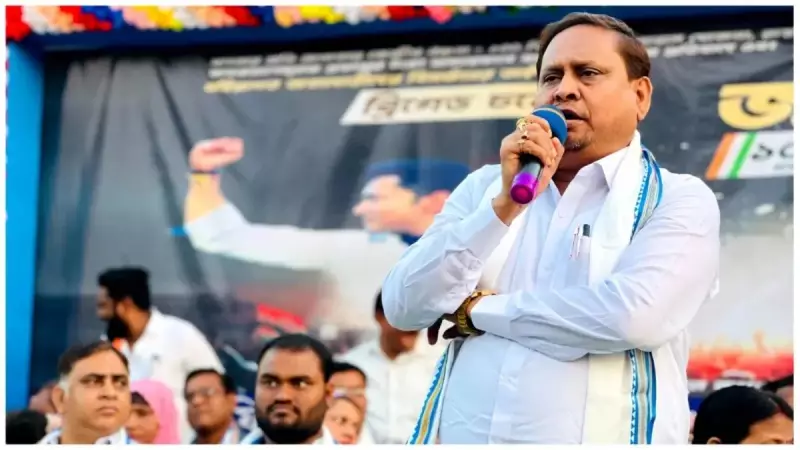
A significant political development is unfolding in West Bengal, where a recent public rally has sent ripples through the state's charged political landscape. The event, which took place on December 18, 2025, featured a striking replica of the Babri Masjid and has catapulted a relatively new figure, Humayun Kabir, into the spotlight as a potential voice for the Muslim community. This move is seen as a direct challenge to Chief Minister Mamata Banerjee's Trinamool Congress (TMC) ahead of the crucial 2026 Assembly elections.
The Rally That Changed the Narrative
On a Wednesday in Kolkata, thousands gathered for a rally organized by the All India Majlis-e-Ittehadul Muslimeen (AIMIM). The centerpiece was a meticulously crafted replica of the Babri Masjid, a powerful and symbolic gesture aimed at mobilizing Muslim voters around issues of identity and historical justice. While AIMIM's national president, Asaduddin Owaisi, addressed the crowd, it was the state unit president, Humayun Kabir, who commanded significant attention.
Analysts observe that Kabir, through this event, is strategically positioning himself as a distinct Muslim leader in Bengal, a space traditionally dominated by Mamata Banerjee's assurances and welfare schemes. The rally's timing, just months before the state goes to polls in 2026, is no coincidence. It signals a deliberate attempt to fragment the Muslim vote bank, which has been a stronghold for the TMC for over a decade.

Political Calculations and Mamata's Challenge
The emergence of a clear Muslim-centric political narrative poses a substantial threat to Mamata Banerjee's electoral arithmetic. The TMC has long relied on a coalition of support from various communities, with a significant portion coming from Muslim voters. The rally, and Kabir's rising profile, threatens to disrupt this consolidation.
Political experts suggest that the Babri Masjid replica was not merely a religious symbol but a potent political tool. It was intended to evoke memories and sentiments that could translate into electoral discontent against the ruling party. The Mamata Banerjee-led government now faces the twin challenge of countering this new narrative while maintaining its broader secular image and fending off the main opposition, the Bharatiya Janata Party (BJP).
The BJP, on its part, is likely to use this development to reinforce its own narrative about vote bank politics and minority appeasement. This creates a complex triangular contest where the TMC's grip on its core supporters is being tested from multiple sides.
Who is Humayun Kabir?
Humayun Kabir, as the West Bengal president of AIMIM, is not entirely new to politics but his current ascent marks a new chapter. His leadership of the December 18 rally has established him as a prominent face of the party's aggressive foray into Bengal. By directly invoking the Babri Masjid issue, he is appealing to a sense of historical grievance and positioning AIMIM as the sole authentic defender of Muslim political interests in the state, a claim that directly contests the TMC's record.
Implications for the 2026 Assembly Elections
The fallout from this rally is expected to shape strategies for the upcoming 2026 Assembly elections. The key implications include:

- Vote Fragmentation: The most immediate risk for the TMC is a split in the Muslim vote. Even a small shift away from the TMC towards AIMIM could alter results in closely contested seats, potentially benefiting the BJP.
- Shift in Political Discourse: The campaign discourse may now increasingly revolve around issues of religious identity and representation, moving beyond the traditional development and welfare debates.
- Testing TMC's Strategy: Chief Minister Mamata Banerjee will need to recalibrate her outreach. She may intensify her government's pro-minority welfare announcements while also launching a strong counter-campaign to discredit AIMIM's influence and question its motives.
- BJP's Potential Gain: A divided opposition vote is often advantageous for a strong third force. The BJP will aim to consolidate the Hindu vote further while highlighting the rally as evidence of divisive politics by other parties.
In conclusion, the rally of December 18, 2025, has undeniably altered the political equations in West Bengal. Humayun Kabir's emergence as a vocal leader using potent symbolism has rattled the ruling establishment. As the state marches towards the 2026 polls, the battle is no longer just between the TMC and the BJP. A third axis, represented by Kabir and AIMIM, has firmly planted its flag, promising a fiercely competitive and unpredictable electoral battle. The coming months will reveal whether this marks a permanent realignment or a temporary disruption in Bengal's politics.