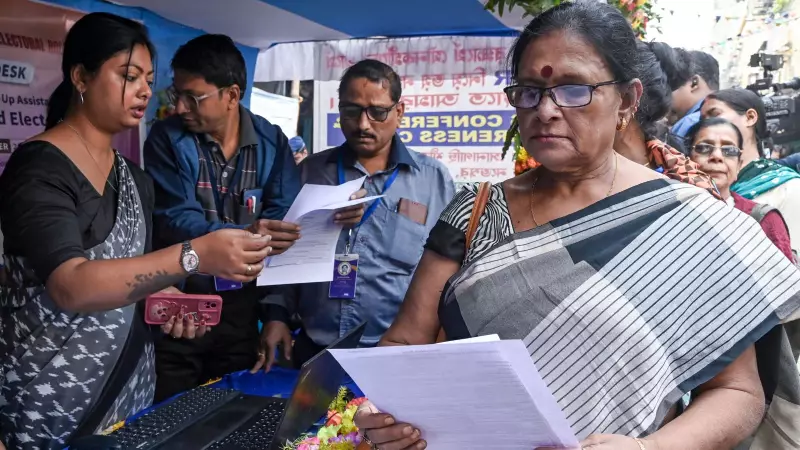
The recently published draft electoral rolls for West Bengal have revealed a significant reduction in the state's voter base, sparking intense political debate. The provisional list shows a sharp decline of approximately 58 lakh voters, shrinking the electorate from 7.66 crore to 7.08 crore. The deletions, attributed to reasons like death, permanent migration, duplication, and non-submission of forms, show a distinct geographical and demographic pattern that challenges prevailing political narratives.
A Tale of Two Trends: High Deletions vs. Minimal Impact
A detailed analysis of the draft rolls indicates a clear divergence. Assembly constituencies with a sizable Hindi-speaking population are among the top ten seats witnessing the highest percentage of deletions, ranging from 15% to a staggering 36%. In stark contrast, numerous Muslim-dominated constituencies across the state recorded only marginal or negligible deletions.
This trend is prominently visible in and around Kolkata. The Kolkata North and Kolkata South districts saw deletions of 25.92% and 23.82% of their electorate, respectively. Key constituencies in the capital, many with significant Hindi-speaking populations, featured prominently on the high-deletion list. These include Jorasanko (36.66% deleted), Chowringhee (35.45%), Kolkata Port (26.09%)—represented by TMC leader and Kolkata Mayor Firhad Hakim—and Chief Minister Mamata Banerjee's own constituency, Bhabanipur (21.55%).
Political Strongholds and Community-Wise Data
The data also reflects on political fortresses. Constituencies where the Bharatiya Janata Party (BJP) has a strong organizational footprint or is a close competitor to the ruling Trinamool Congress (TMC) have seen high deletion rates. These include Howrah Uttar (26.89% deletion), Asansol Dakshin (13.68%), Asansol Uttar (14.71%), and Barrackpore (19.01%).
Furthermore, seats dominated by the Matua community, a key voter base for the BJP, also recorded significant deletions in this phase. Examples include Kasba (17.95%) and Sonarpur Dakshin (11.29%) in South 24 Parganas, and Bongaon Uttar (9.71%) in North 24 Parganas.
On the other end of the spectrum, Muslim-majority districts like Murshidabad and Malda, where Muslims comprise 66.3% and 51.6% of the population per the 2011 Census, saw only 4.84% and 6.31% deletions overall. In none of the Assembly seats in these districts did the deletion figure cross 10%. This pattern held in other minority-dominated seats in Uttar Dinajpur and Birbhum districts as well.
Reactions and Expert Analysis: Debunking Narratives
The draft roll data has ignited a war of words between major political parties. TMC spokesperson Arup Chakraborty stated, "The BJP's narrative stands on lies. The draft rolls show that people from Uttar Pradesh and Bihar are in Bengal, not infiltrators from Bangladesh." He criticized the Centre for conducting the Special Intensive Revision (SIR) before a national Census.
BJP leader Rahul Sinha countered by alleging that Booth Level Officers could not work impartially due to pressure from the TMC, a claim his party has raised with the Election Commission.
Experts analyzing the data suggest it deflates the political narrative of "infiltration." Kolkata-based researcher Sabir Ahamed of the Pratichi Trust explained, "West Bengal has been a destination for migrants from neighbouring states for years. They may have opted for their native place in voter rolls as that is tied to their primary identity and land. Hence, we see higher deletions in Hindi-speaking areas."
Echoing this, former MP and CPI(M) leader Sujan Chakraborty noted that migrant workers from Bihar and UP might have chosen to keep their names in their home states' electoral rolls. He added, "I have been saying that the SIR will put poor Hindus into trouble much more than poor Muslims."
Researcher Ashin Chakraborty pointed out that the data indicates Muslims are less likely to be affected by voter mapping issues due to better document availability. "The data shows Matuas and the non-Bengali migrant labour population are likely to face the maximum exclusion," he concluded.
The draft rolls are provisional, with a phase for claims and objections to follow. However, the initial data has already set the stage for a heated political contest, framing the debate around migration, identity, and electoral inclusion in West Bengal.