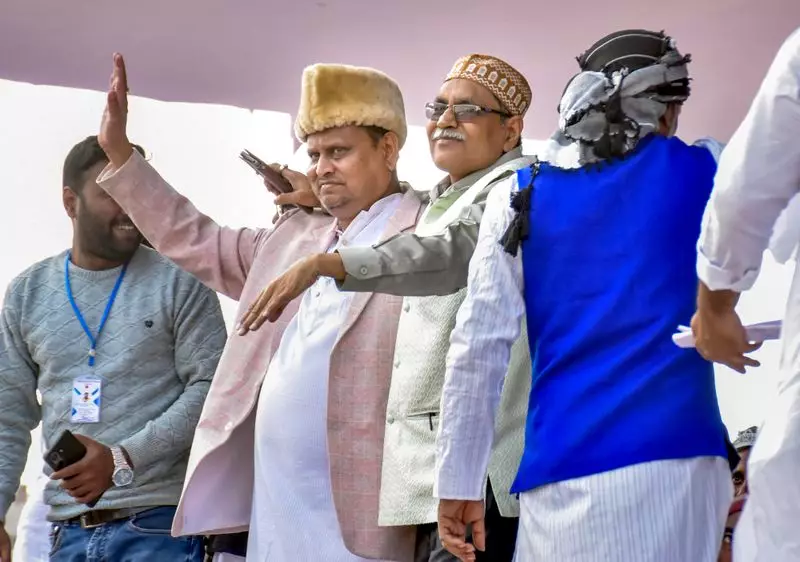
In a significant political development in West Bengal, Humayun Kabir, the Independent MLA from Suti constituency in Murshidabad, has announced the formation of a new political party. This move comes merely days after he was involved in a highly publicized event—laying the foundation stone for a mosque intended to be built in memory of the Babri Masjid demolition.
From Mosque Foundation to Political Formation
The sequence of events has captured significant attention. On Sunday, February 25, Kabir, along with supporters, performed the groundbreaking ceremony for a mosque in the Suti area. He explicitly stated the structure was envisioned as a tribute to the Babri Masjid, which was demolished in Ayodhya in 1992. The act was seen as a potent symbolic gesture in the region's socio-political landscape.
Fast forward to Tuesday, February 27, and the MLA took a decisive turn towards formal political organizing. He unveiled his new party, named the 'Jana Sangrami Manch' (People's Struggle Platform). Kabir declared that the party's primary objective is to champion the rights and address the issues faced by minorities, backward classes, and farmers within the state.

Strategic Timing and Political Motivations
The timing of these two events—the religious foundation and the political launch—appears deeply interconnected. Analysts suggest the mosque ceremony served to consolidate a specific voter base and highlight Kabir's stance on a historically sensitive issue. The subsequent party formation capitalizes on the momentum and media attention generated by that event.
Kabir, who was originally elected as a Trinamool Congress (TMC) candidate in 2021, later chose to function as an independent legislator after distancing himself from the ruling party. His new political venture is widely interpreted as a direct challenge to the TMC's dominance in his constituency and a bid to carve out a distinct political identity ahead of future elections.
Reactions and Potential Ramifications
The announcement has stirred the political waters in West Bengal. While Kabir's supporters have welcomed the move as a necessary step for representation, leaders from established parties are watching closely. The move is expected to further fragment the political landscape in Murshidabad, a district known for its complex electoral dynamics.
The foundation-laying event for the mosque had already drawn criticism from some quarters, with opponents accusing Kabir of indulging in divisive politics. The launch of the Jana Sangrami Manch is likely to intensify this debate, framing him as a figure willing to blend religious symbolism with political ambition.
Key questions now arise about the party's structure, alliance possibilities, and its actual impact on the ground. Will it attract other disaffected leaders? How will it position itself amidst the fierce TMC-BJP-Congress-Left competition in Bengal? The answers to these will unfold in the coming months as Kabir's new platform begins its political journey.
For now, the creation of the Jana Sangrami Manch marks a bold and calculated entry by an independent MLA into the crowded arena of West Bengal politics, setting the stage for a new kind of contest in the region.