

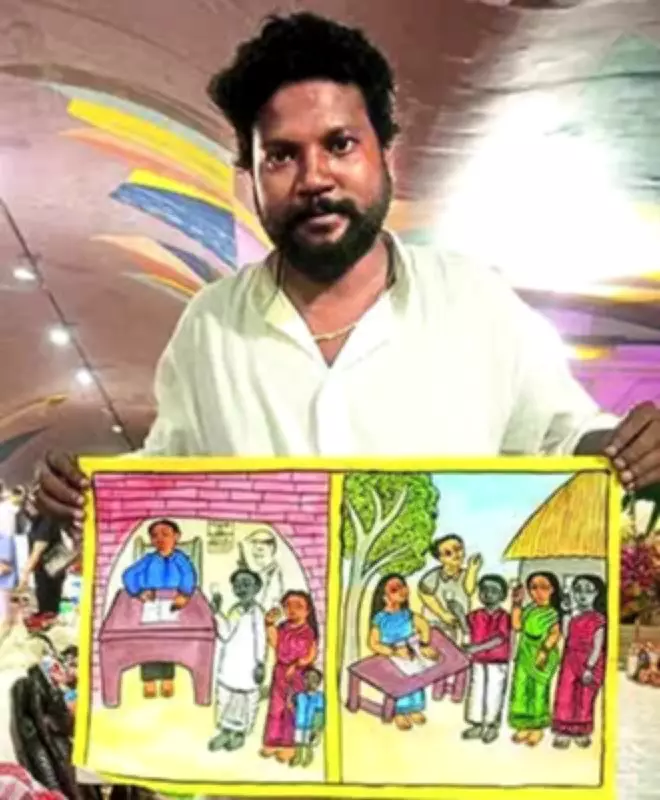
Patachitra Artists in Bengal Turn Traditional Scrolls Into Voter Rights Protest
In the heartland of West Bengal's patachitra tradition, where mythological tales have been painted on scrolls for centuries, a new and deeply personal narrative is emerging. Artists in Pingla block of West Midnapore district are channeling their craft into a powerful protest against what they describe as the denial of their fundamental democratic right: the right to vote.
Vanishing Ballots in the Village of Scrolls
Naya village, home to approximately 300 patachitra artists, has become the epicenter of this artistic uprising. Following the Summary Revision of electoral rolls, residents report that at least 34 names have been struck off the poll lists. Most affected artists come from Muslim families bearing the surname "Chitrakar," with women reportedly outnumbering men among those removed. This community, traditionally custodians of storytelling through painted scrolls rooted in epics like the Ramayana and Mahabharata, now finds its own story being rewritten in troubling ways.
Art Transformed Into Testimonial
The response has been both poignant and powerful. Artist Bahadur Chitrakar has created an eight-frame series that traces the fear and uncertainty gripping his community. One frame poignantly compares voters' lives to kite strings that could snap at any moment. "Elections are like festivals for us," Bahadur explains. "This year, however, sadness has taken over the celebration."

Siraj-ud-daulah Chitrakar's scrolls revisit childhood memories of walking to polling booths with parents, contrasting them with current realities where residents are asked to prove their belonging. "Through our art, we are showing that we are Indians, that we belong here," he asserts.
Patterns of Exclusion Among Honored Artists
The affected individuals include relatives of nationally recognized artists such as Swarno Chitrakar and Anwar Chitrakar. Many had been registered voters for years in booth 183 of the Sabang assembly constituency. Rahim Chitrakar, treasurer of the artists' collective Chitrataru, confirms the concern: "At least 34 artists have been excluded post-SIR."
Sanuyar Chitrakar, 40, represents a particularly baffling case. Despite submitting extensive documentation linking his credentials to his father (listed in 2002 rolls) and presenting a land deed over fifty years old, his name disappeared while his siblings remained on the list. Called for a hearing over a "logical discrepancy," he produced required papers and even offered his passport. "They said it wasn't needed," he recalls. After judicial scrutiny, his name was removed, prompting him to approach a tribunal established under Supreme Court directions.
Widespread Impact Across Families
Other artists share similar experiences. Anur Chitrakar found her name missing from the February 28 published list, with her husband also excluded despite submitting his passport. In Bahar Chitrakar's family, which includes senior artists praised by the President, four names have been deleted.
The irony is not lost on Seramuddin Chitrakar, whose Ramayana-themed scroll once drew praise from Prime Minister Narendra Modi. "I don't know why my wife's name was deleted," he says, highlighting the personal nature of these bureaucratic decisions.
Jahanara Chitrakar recounts being the only sibling left out despite identical documentation. "All five of my siblings are on the list. I am not," she states, underscoring what appears to be inconsistent application of scrutiny.
From Mythology to Modern Protest
What was once a medium for mythological narrative has undergone a sharp transformation. Patachitras (the long painted scrolls) and pater gan (songs sung during their unfurling) now recount hearings, document submissions, and rejections. In Naya, where art traditionally travels through song and story, anger now flows through paint and pigment.

This artistic protest represents more than individual grievances; it is a collective assertion of identity and rights through cultural expression. As the patachitra artists of Bengal prepare their scrolls not for temples or festivals but for democratic accountability, each stroke carries a question about inclusion, and each refrain demands an answer about belonging in the world's largest democracy.





