A significant political storm has erupted in West Bengal following the alleged presence of the state's topmost bureaucrats alongside Chief Minister Mamata Banerjee at the office of political consultancy firm I-PAC during an Enforcement Directorate (ED) raid. The incident, which occurred on Thursday, January 9, 2026, has drawn sharp criticism from opposition parties, accusing the Trinamool Congress (TMC) government of blatantly mixing governance with politics.
The Raid and the Controversial Visit
The Enforcement Directorate conducted simultaneous searches at multiple locations in Kolkata and Bidhannagar on Thursday. The raids were part of a money laundering investigation connected to the multi-crore coal smuggling scam. Among the premises searched was the office of I-PAC (Indian Political Action Committee) located on the 11th floor of a building in Salt Lake's Sector V.
According to the central agency, proceeds from the coal scam, amounting to crores of rupees, were allegedly funneled to I-PAC through hawala channels. Other locations raided included the Loudon Street residence of I-PAC director Pratik Jain and a trader's office in Posta, Burrabazar.

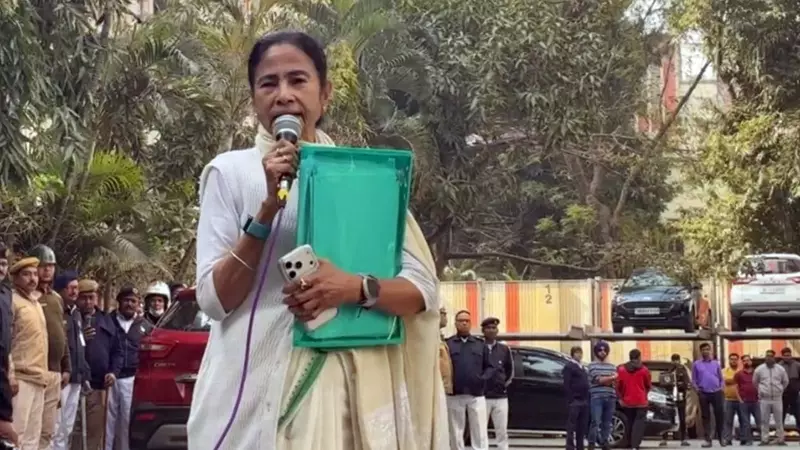
The controversy ignited when Chief Minister Mamata Banerjee first visited Pratik Jain's residence during the raid, where she allegedly took possession of some files, a laptop, and documents. She then proceeded to the I-PAC office in Salt Lake. It was here that the presence of Chief Secretary Nandini Chakravorty and Principal Secretary to the CM Manoj Pant, along with other senior officials, was noted, escalating the situation into a full-blown administrative and political row.
Political Reactions and Accusations
The Chief Minister later stated on Friday, January 10, that she had visited the location in her capacity as the chairperson of the Trinamool Congress, not as the head of the state government. This clarification, however, did little to quell the criticism.
Jagannath Chattopadhyay, the state vice-president of the BJP, launched a sharp attack, stating that in West Bengal, politics and governance have become "completely mixed." He accused the Chief Minister of being unable to differentiate between governmental and non-governmental practices and claimed that senior IAS officers were now entangled in the political machinery.
Echoing similar sentiments, Sujan Chakraborty, a CPI(M) Central Committee member, questioned the need for the Chief Secretary and Principal Secretary to be part of the CM's security detail at a political party's consultant's office during a federal agency's operation. He alleged a "friendly match" between the state and the Centre, implying collusion.
Historical Precedent and Administrative Norms
The incident has prompted discussions about administrative propriety. A senior state official, speaking anonymously, highlighted that while police officers accompany the CM for security, there was no need for top civil servants to physically rush to a site where a central agency was conducting a search. The official contrasted the current scenario with the tenures of former Chief Ministers Jyoti Basu and Buddhadeb Bhattacharjee, who reportedly never summoned officers to party offices or residences.
A former IAS officer recalled a 2019 incident when Mamata Banerjee staged a dharna after a CBI raid. At that time, the then Chief Secretary Malay De had refused to join the protest podium when a Cabinet meeting was proposed there, ultimately leading to the meeting being held at a nearby government premises.
The unfolding drama underscores the deepening tensions between the West Bengal government and central investigative agencies, while raising serious questions about the separation of administrative duties from political activities. The fallout from this raid and the subsequent reactions are likely to dominate the state's political discourse in the coming days.