Bhopal's Road Network Braces for Summer Crisis Amid Soaring Bitumen Costs
The city of Bhopal is confronting a severe challenge this summer as its road repair and resurfacing plans are at risk of derailment due to skyrocketing bitumen costs, exacerbated by ongoing conflicts in West Asia. Bitumen, a crucial petroleum byproduct used to bind asphalt in road construction, has seen significant price increases starting March 2026, placing immense pressure on project budgets across the region.
Immediate Impact on Public Works and Municipal Projects
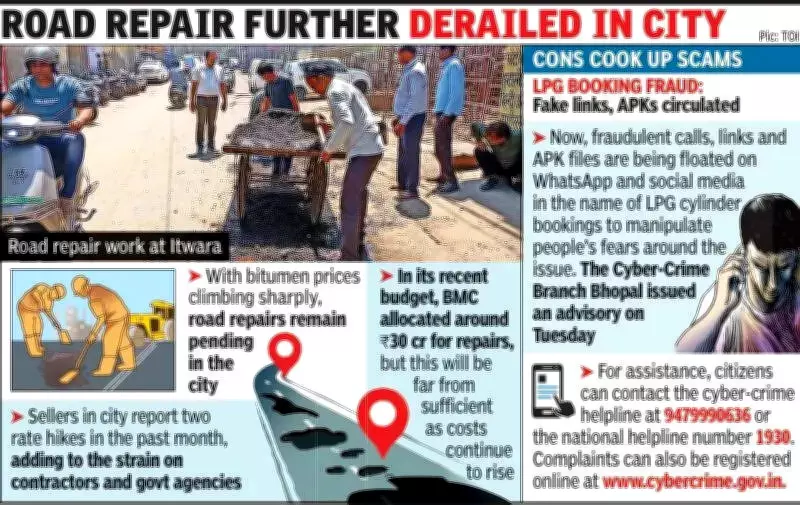
On a recent Tuesday in Itwara, a Public Works Department (PWD) sub-engineer oversaw the relaying of a small, potholed road section that had been excavated for sewage laying around 2024. The focus was not only on repairing the damaged stretch but also on conserving the limited stock of bitumen. The situation is alarming, the sub-engineer stated, requesting anonymity, noting that the PWD is currently relying solely on existing supplies. Future projects face considerable budget uncertainty, with no clear plan to address cost escalations.
Earlier this year, the PWD identified 180 roads in need of relaying, most of which require cement and bitumen layering. Meanwhile, the Bhopal Municipal Corporation (BMC) manages nearly 1,500 kilometers of roads, half of which are potholed and urgently require resurfacing. In its recent budget, the BMC allocated approximately Rs 30 crore for repairs, but this amount is expected to fall short as costs continue to climb.

Bitumen Price Surge and Market Dynamics
Bitumen prices in India have risen steadily throughout March 2026, with bulk grades increasing by Rs 4,000 to Rs 5,000 per tonne compared to early March. The most substantial gains were observed at Vizag and other refinery depots, reflecting higher crude oil costs and tight supply conditions. In Bhopal, sellers report two rate hikes in the past month alone, adding strain to contractors and government agencies tasked with infrastructure maintenance.
Exploring Alternatives and Facing Challenges
Authorities are now considering alternatives such as white topping, which involves applying concrete overlays on existing roads. While this method offers greater durability, it comes with higher upfront costs and slower implementation times, raising questions about its scalability for widespread use.
Metro Corridor and Sewage Projects at Risk
The rising cost of bitumen could soon impact the Bhopal Metro corridor, which commenced passenger services last December. Although trains operate on elevated tracks, the road beneath remains in need of repair. Responsibility for this stretch lies with the Madhya Pradesh Metro Rail Corporation Limited (MPMRCL), whose officials confirm that payment was made to the PWD last year for the work. However, with bitumen prices climbing sharply, the repairs are still pending, raising concerns that the corridor's supporting road infrastructure may lag behind the metro's rapid development.
Additionally, Bhopal's ongoing sewage line development under the AMRUT 2.0 scheme, spanning nearly 700 kilometers, faces new challenges. As pipeline work progresses, the resurfacing of dug-up roads is becoming increasingly expensive, further straining already limited budgets and threatening to slow down restoration efforts.
In summary, Bhopal's infrastructure projects are at a critical juncture, with rising bitumen costs driven by global tensions posing a significant threat to road repairs and related developments. Stakeholders must navigate these financial pressures while seeking sustainable solutions to maintain the city's road network.