

A decision by jewellers in Bihar to refuse entry to customers with covered faces has ignited a political firestorm, with the Rashtriya Janata Dal (RJD) strongly condemning the move as "unconstitutional" and targeted against a specific community.
Security Measure or Targeted Ban?
The controversy erupted on Wednesday after the Bihar unit of the All India Jewellers and Goldsmith Federation (AIJGF) announced its new policy. State AIJGF president Ashok Kumar Verma explained the rationale to reporters, stressing that the restriction was born from genuine security concerns and not aimed at any community.
"The decision we took was based purely on security concerns," Verma stated. He pointed out that jewellery is a high-value commodity and that incidents of robbery often involve individuals concealing their identities. "The issue arises when people come into shops hiding their faces with helmets, turbans, or veils, and commit robberies," he clarified. Verma also assured that no staff member would forcibly remove anyone's face cover.

RJD's Fierce Opposition
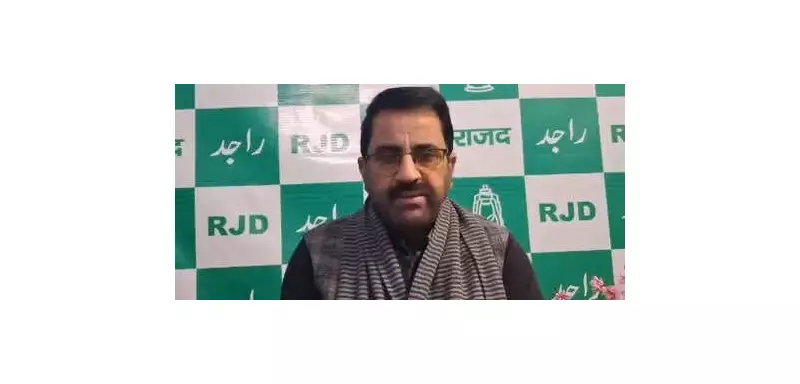
Despite this clarification, the main opposition party, the RJD, launched a sharp protest. Party spokesperson Ejaz Ali Ahmad accused the federation of targeting a particular community under the guise of security. He declared the move "totally unconstitutional."
"The move not only targets a particular community in the name of security, but also hurts their religious sentiments," Ahmad alleged on Wednesday. He framed the ban as a direct assault on constitutional guarantees. "The move amounts to an attempt to curtail the fundamental right to religious freedom guaranteed by the Constitution," he said.
Allegations of a Larger Conspiracy
The RJD spokesperson went a step further, weaving a narrative of a broader agenda. Ahmad claimed that initially, "Hindutva forces" were behind this "conspiracy," and now jewellery shops were advancing the same objective. He demanded the immediate withdrawal of the ban order, describing it as an unacceptable attack on religious freedom.
The clash highlights the delicate balance between business security and religious practice in India. While the jewellers' federation insists its policy is a neutral security protocol, the RJD's vehement reaction underscores the deep-seated political and social sensitivities surrounding issues of identity and faith in the state.






