Bihar Transport Minister Takes Strict Action Over Abysmal Revenue Collection
In a decisive move, Bihar State Transport Minister Shrawan Kumar has ordered stringent measures against officials responsible for severely poor revenue collection across multiple districts. The minister has issued show-cause notices to a total of 40 officials, demanding explanations for the dismal performance that has seen some districts achieving a mere 8% of their assigned financial targets.
Show-Cause Notices Issued During Departmental Review
The action was initiated during a comprehensive departmental review meeting held on Wednesday, where Minister Kumar highlighted serious lapses in revenue generation. The officials who have been served notices include 10 District Transport Officers (DTOs), 10 Additional District Transport Officers (ADTOs), along with several Motor Vehicle Inspectors (MVIs) and Enforcement Sub-Inspectors (ESIs).
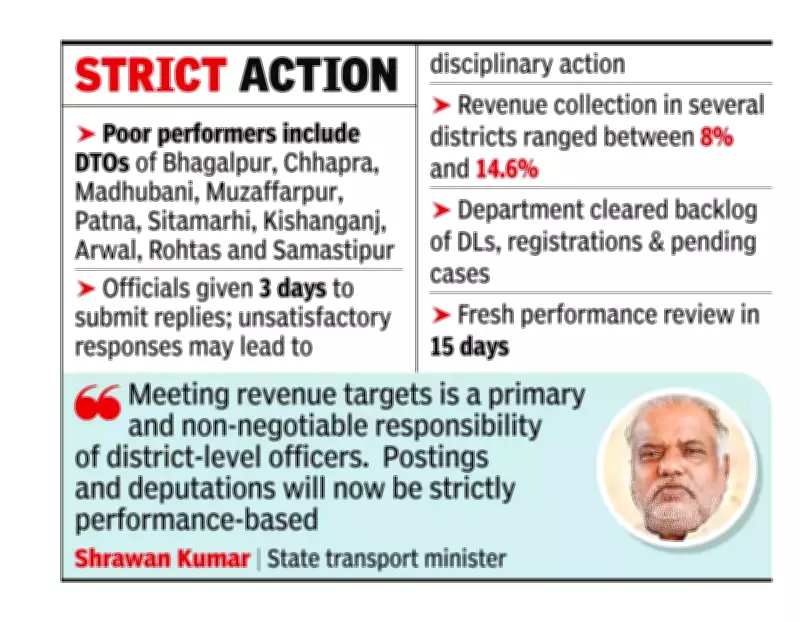
"Officials have been given a strict deadline of three days to submit their detailed replies. If the responses are found unsatisfactory, the department will initiate formal disciplinary proceedings by constituting an inquiry under the relevant service rules," stated Minister Shrawan Kumar, emphasizing the gravity of the situation.
Persistent Underperformance Despite Grace Period
The minister pointed out that despite granting a two-month grace period earlier to allow for improvement, the districts consistently failed to enhance their revenue collection performance. Kumar stressed that meeting revenue targets is a primary and non-negotiable responsibility for all district-level officers, and the persistent gaps indicate serious administrative shortcomings that cannot be overlooked.
Departmental data reveals alarming figures, with revenue realization in many districts remaining critically low, ranging between 8% and 14.6% of the assigned targets. The worst performers include:
- Bhagalpur DTO Janardan Kumar – achieved only 8% against a target of Rs 200 lakh
- Chhapra (Saran) DTO Latifur Ansari – 8.2% against Rs 400 lakh
- Madhubani DTO Ram Babu – 8.6% against Rs 200 lakh
- Muzaffarpur DTO Kumar Satyendra Yadav – 9.2% against Rs 300 lakh
- Patna DTO Upendra Kumar Pal – 10% against Rs 400 lakh
- Sitamarhi DTO Prashant Kumar – 10% against Rs 160 lakh
- Kishanganj DTO Dikshit Shweta – approximately 12% against Rs 150 lakh
- Arwal DTO Amanpreet Singh – 14.6% against Rs 150 lakh
Similar patterns of underperformance were recorded in districts such as Rohtas and Samastipur, further highlighting the widespread nature of the issue.
Wide Range of Officials Under Scrutiny
At the ADTO level, notices have been served to officials from Kishanganj (Salim Prashant), Madhubani (Upendra Rao), Patna (Pinku Kumar), Muzaffarpur (two officers), Sitamarhi, Vaishali, Bhojpur, Siwan, Motihari, and several other districts.
Among the Motor Vehicle Inspectors, those posted in Muzaffarpur (Sidhu Kumar), Bettiah (Anup Kumar Singh), Nawada (Parth Sarathi), Motihari, Madhubani, and Gaya (two officers) have received notices. Additionally, Enforcement Sub-Inspectors from Bhojpur, Supaul, Madhubani, Bettiah, Buxar, Muzaffarpur, Madhepura, Lakhisarai, Nawada, and other locations have also been issued show-cause notices.
Shift to Performance-Based Postings and Future Reviews
Minister Kumar announced a significant policy shift, stating that all future postings and deputations within the transport department will now be strictly performance-based. "While revenue targets were not met, the department acknowledges progress in other areas," he noted, providing a balanced perspective.
He highlighted that officials recently undertook special drives to clear pending cases related to driving licenses, vehicle registrations, and other essential services, resulting in a substantial reduction in backlog. To ensure continuous monitoring, a fresh performance review of the concerned officials is scheduled to take place within the next 15 days.
This crackdown underscores the Bihar government's commitment to accountability and efficiency in public administration, particularly in revenue-sensitive departments. The move is expected to set a precedent for other states grappling with similar challenges in meeting financial targets through improved governance and stricter oversight.