

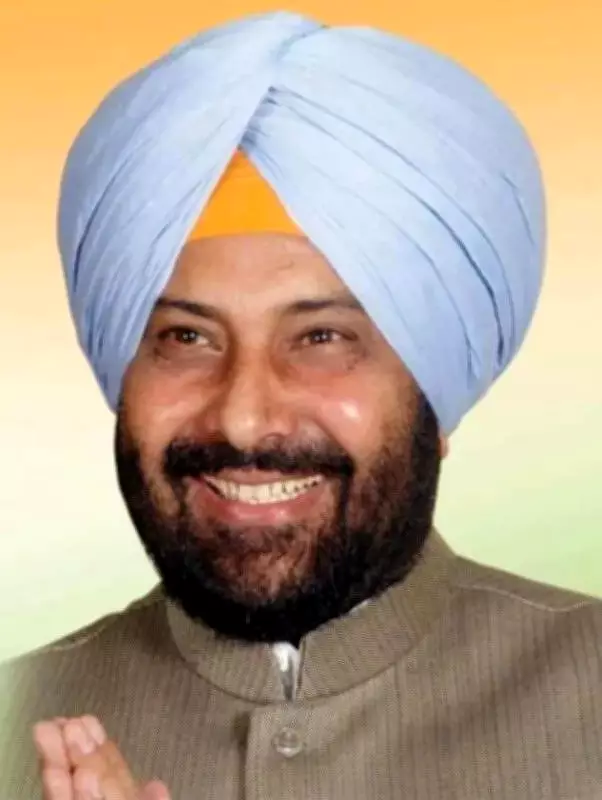
Jalandhar: In Kewal Singh Dhillon, BJP's Punjab unit got its second Sikh and first Jat Sikh president. He replaced a Hindu Jat, Sunil Jakhar, who happened to be the first Jat to hold the post in BJP.
Dhillon, who took to the turban after joining politics, has been appointed as an outreach to the politically dominant Jat Sikh community even as the saffron party's socio-political engineering project aims to make inroads among OBCs and Scheduled Castes, with promises of more power sharing. The party already has a very strong presence among upper-caste Hindus.
During the farm movement, in Dec 2020, Punjab BJP's organising secretary Dinesh Kumar told TOI that Jat Sikhs dominated the state politically and what happened in Haryana politics could be replicated in Punjab too, arguing that 82% (non-Jat-Sikhs) of the population did not get a proper share in power.

"When it became Jat versus all others in Haryana, BJP formed a govt. If this can happen in Haryana, (where Jats dominated politically and most CMs were also Jats) Punjab is no different," Dinesh argued.
What Kumar said directly six years ago still appears to be BJP's baseline for its socio-political engineering.
Notwithstanding what is being said in public about the numbers of Jat Sikhs, BJP is known for data crunching, working as hard on the drawing board as on the ground, a good part of which involves working subtly especially where RSS and its affiliates are involved. While speculation persists on the percentage of Jat Sikhs in Punjab, as there has been no caste census, those arguing against their political dominance often understate their population share, as is evident from Dinesh's claim. Various political leaders and commentators have been putting the Jat-Sikh percentage below or around 20%. Big emigration from the villages, especially among Jat Sikhs, is also considered a contributing factor.
However, data from Lokniti - Centre for the Study of Developing Societies (CSDS), gleaned from surveys around elections from 2002 to 2022, reflect that Jat Sikhs still make around 30% of the voters, despite a decline of over 5% in two decades. While the percentage of other caste-religious groups vary, sometimes very significantly, apparently due to their small sample size, Jat Sikhs happen to be the only caste-religious identity group which reflects consistency in the percentage.
In the Lokniti-CSDS survey during the 2002 assembly election, Jat Sikhs were 35.4% of the electorate. What followed was a steady decline -- 34.9% in 2007, 29.3% in 2012 and 29.2% in the 2017 post-poll survey. Two surveys prior to the 2017 election put this figure at 29.5% (Dec 2016) and 28.4%. In the last assembly election, Jat Sikhs were 29.6% of the electorate.
This downward graph is mirrored by an upswing in emigration among young Punjabis, which spread from rural Punjab to urban areas. And it was reflected in the Total Fertility Rate (TFR) of just 1.4 in 2024.
This percentage of Jat Sikhs in the Lokniti-CSDS survey is in line with the last caste census held in 1931. In the total population of 2,84,90,857 in Punjab in 1931, Sikhs were 40,71,624. With a headcount of 21,34,598, Jat Sikhs made up 52% of the Sikh population.
After Partition in 1947, Punjab was reorganised on language basis in 1966. According to the 2011 census, Sikhs were nearly 57.7% of Punjab's population. If the percentage of Jat Sikhs from 1931 were extrapolated to present-day Punjab, they would make at least 30% of the population now.
As allocation of agricultural land in lieu of the land left behind in West Punjab took place only in East Punjab (which then included Haryana), the concentration of agrarian communities, among whom Jat Sikhs remain the largest, would have increased in present-day Punjab. The 2002 Lokniti-CSDS survey reflected their percentage as 35.4% -- and before that it could be even higher.
Apart from sheer numbers, these are the optics, which are equally important for the saffron party, and explain the paradox, when working on socio-political engineering - Jat Sikhs versus others, they have a turbaned Jat as the state president.






