In a significant political development, senior Bharatiya Janata Party (BJP) leader and former chief minister Arjun Munda has launched a sharp critique against the Jharkhand government's recently notified rules for the Panchayats (Extension to Scheduled Areas) Act, 1996. This comes just days after the Hemant Soren-led administration issued the PESA Rules 2025, a first for the state since its formation.
A Clash Over Tribal Rights and Definitions
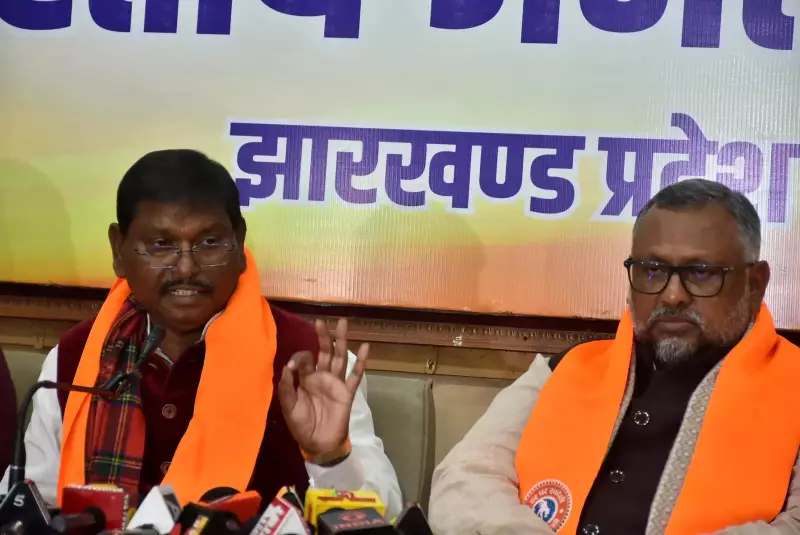
Arjun Munda, who also served as the Union Tribal Affairs Minister, did not mince words on Sunday. He labeled the newly framed rules as "contrary to the original spirit of the PESA Act, 1996." He launched a direct attack on the ruling dispensation, accusing it of "cleverly trying to change the definition of tribals."
Munda emphasized that the demand for implementing PESA rules in Jharkhand had persisted for a long time, with many approaching the courts, which ultimately pressured the government to act. He argued that self-governance is an intrinsic part of the traditional tribal system, preserved since ancient times. "But going by the rules which were notified, it looks that the state government has struck at the very soul of the tribal society's self-governance model," he stated.

He clarified that while state governments are required to formulate rules for the better implementation of the 1996 Act, no government has the right to tamper with its basic spirit.
Core Controversy: The Definition of Gram Sabha
Elaborating on his party's objections, the former Union minister pinpointed a fundamental divergence. "In the PESA rules declared by the Jharkhand government, the inherent definition of Gram Sabha is different from the original PESA Act," Munda explained.
He detailed that the original Act defines the Gram Sabha based on customary law, religious practices, and long-continuing traditions. He alleged that the new state rules have diluted this crucial aspect. Munda further highlighted that nine other states where PESA is applicable have defined the Gram Sabha in accordance with the original Act, implying Jharkhand has deviated from the established path.
Another criticism leveled by Munda was about the substance of the rules. He maintained that despite the document being voluminous, it lacks proper content and could potentially create a situation of anarchy in the future.
Ruling Alliance Rallies in Defense
The Congress party, a key partner in the ruling alliance and holder of the state's Panchayati Raj department portfolio, swiftly came to the defense of the government's move.
Party spokesperson and general secretary Alok Dubey countered the BJP's allegations, urging them to stop spreading confusion. "The rules brought by the Hemant Soren government are after lots of consultation with all stakeholders," Dubey asserted.
He framed the notification as a historic achievement, noting that no previous BJP government in the state had managed to enact these rules. "By bringing the rules, the Hemant government has given rights to those living in Scheduled Areas," he claimed.
Dubey dismissed the BJP's discourse as being driven by "confusion, half-truths, and political frustration." He concluded by firmly stating that the Jharkhand PESA rules make the Gram Sabha the center of every decision-making process, thereby strengthening, not weakening, the spirit of the 1996 Act.
The political battle over the interpretation and implementation of PESA rules in Jharkhand is now set to intensify, with both sides digging in their heels on an issue central to tribal identity and autonomy in the state.