Centre Agrees to Shift Punjab Border Fence, Easing Farmer Woes
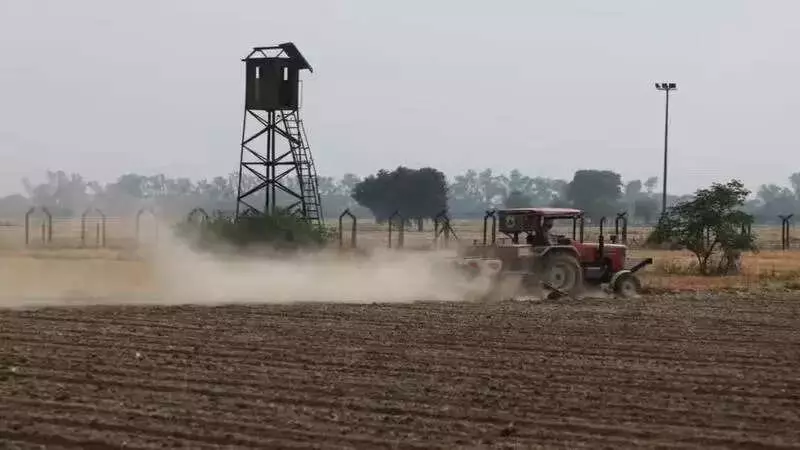
Punjab Chief Minister Bhagwant Mann made a significant announcement on Saturday. He claimed the Central government has agreed in principle to relocate the border security fence closer to the international border. This move will enable unhindered cultivation of thousands of acres of farmland currently trapped beyond the barrier.
Assurance from the Home Minister
Speaking to the media after his meeting with Union Home Minister Amit Shah in New Delhi, Mann expressed gratitude. He said, "The home minister has given me an assurance. I am grateful that the Centre is actively considering it at my request. It is a big issue for farmers who have their fields across the fence."
Mann added that Shah assured him the relocation would happen in the coming days. The Punjab government will coordinate with the home ministry on implementation steps.

Existing Challenges for Border Farmers
Elaborating on the ordeal faced by farmers along the 532-km Indo-Pak border in Punjab, Mann highlighted severe restrictions. Farmers can only cross the fence with identity cards and under BSF escort to reach their own fields.
He explained that along the international border, fencing is located deep inside Punjab's territory. "As per international norms, construction should be beyond 150 metres of the zero line, but in several areas of Punjab, the border security fence is located two-three kilometres inside," said Mann.
Impact on Agricultural Practices
Farmers in the border belt face multiple constraints that affect their livelihoods:
- To access fields across the fence, they must deposit government-issued identity cards and undergo rigorous frisking by personnel.
- Farmers often work under the direct supervision of BSF's 'Kisan Guards' and generally cannot stay in their fields after sunset.
- For security visibility, BSF prohibits growing crops exceeding three feet in height.
- This restriction prevents cultivation of high-value cash crops like sugarcane or maize, forcing farmers into less profitable monoculture of wheat and specific rice varieties.
- Heavy machinery like combine harvesters must be pre-registered with authorities.
- During cross-border tension, gates are often shut indefinitely, leading to total crop loss.
Previous Experiment in Pathankot
Mann noted that the Centre already experimented with shifting the border fence in the Pathankot area. In June 2018, the BSF decided to shift approximately 20km of fencing in the Pathankot and Gurdaspur sector closer to the border. This move aimed to combat drug smuggling and infiltration.
Additional Demands Raised by Punjab CM
During the same meeting with Amit Shah, Bhagwant Mann raised several other critical issues affecting Punjab:
Release of Pending Funds
Mann demanded the release of pending Rs 9,031-crore rural development fund (RDF) and Rs 2,267.83 crore in market fees. He highlighted that despite clear statutory provisions under relevant Punjab Acts, RDF has not been reimbursed to the state government since 2021-22.
"RDF is not a charity. It is Punjab's rightful share, and we are demanding our due," he asserted. Mann added that the non-release severely impacts rural infrastructure development, including roads and mandis.
Water Sharing Concerns
The CM reiterated that Punjab has no surplus water to share with other states. He cited a substantial decrease in the flow of the Satluj, Ravi, and Beas rivers. Mann termed the Satluj-Yamuna Link (SYL) canal unviable, noting that while these rivers do not flow through Haryana, Delhi, or Rajasthan, those states are allocated 60% of the water.
He maintained that Punjab's 40% allocation (14.22 MAF) represents a "gross injustice" and that the state's firm stand before the Supreme Court remains unchanged.
Food Grain Storage Issues
Mann flagged concerns about shortage of storage space for food grains. He demanded the Food Corporation of India (FCI) increase food grain movement from Punjab to 20 lakh metric tonnes monthly—split equally between wheat and rice.

Currently, only 20 LMT of space is available for 95 LMT of pending rice from the kharif marketing season 2025-26. He urged deployment of special trains to clear stocks before the April 1 wheat harvest to ensure national food security.
Revision of Commission Agent Rates
The CM sought immediate revision of the Arhtiya (commission agent) commission, which has been frozen since 2019-20 and capped at roughly Rs 46 per quintal. He pointed out that the commission at silos was reduced to half of that in regular mandis.
Mann noted that a committee constituted in January 2024 to revise the commission has not taken a decision so far. "Delay in revising the commission can disrupt the smooth procurement process, and the rates should be finalised at the earliest," he warned.
Administrative Concerns in Chandigarh
Raising administrative issues, Mann stressed maintaining the long-standing 60:40 ratio of Punjab and Haryana officers in Chandigarh. He expressed concern over IAS and PCS officers being excluded from key positions and the opening of departments such as excise, education, finance, and health to other cadres.
Mann argued this dilutes Punjab's role in the UT administration and affects the state's interests in the shared capital.
Appointment of FCI General Manager
The CM also took up the issue of appointing a Punjab cadre officer as General Manager of FCI Punjab. He emphasized that Punjab cadre officers have familiarity with procurement, mandis, storage, and movement of food grains.
"We have already written a letter on the issue. The home minister said we should submit a panel of names," Mann revealed.
The meeting between Punjab's chief minister and the Union home minister addressed multiple pressing issues affecting the state's farmers, rural development, and administrative functioning. The in-principle agreement on border fence relocation represents a significant step toward resolving long-standing agricultural challenges along the international border.