Chandigarh Braces for Historic Mayoral Election with Three-Way Contest
In a significant political development for the Union Territory of Chandigarh, the upcoming mayoral election for the municipal corporation is set to witness an unprecedented triangular contest. This marks the first time since the civic body's establishment in 1994 that three major political parties will compete independently for the mayor's position.
Nominations Filed Amid Political Show of Strength
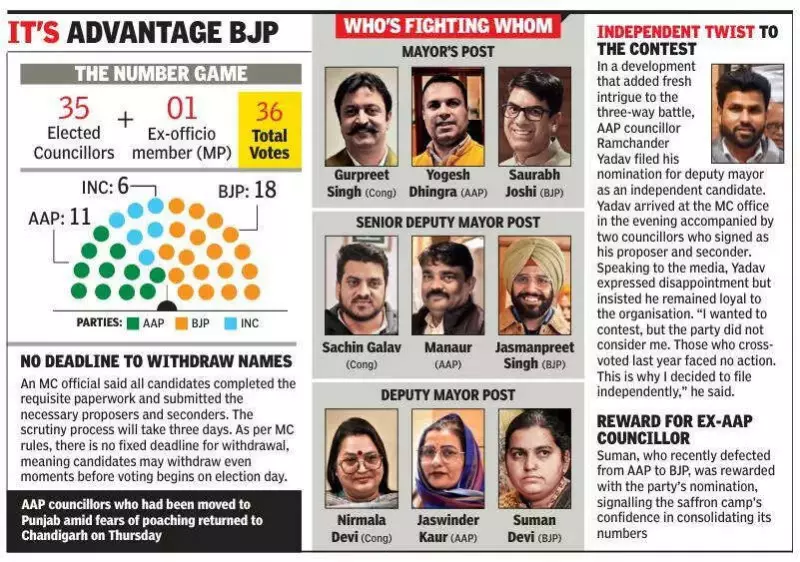
The nomination process on Thursday transformed into a display of political muscle, with the Congress, Aam Aadmi Party (AAP), and Bharatiya Janata Party (BJP) all submitting their candidates accompanied by senior leaders, councillors, and enthusiastic supporters. The long-standing speculation about a potential Congress-AAP alliance was definitively put to rest as both parties chose to contest separately, a decision that has immediately strengthened the position of the ruling BJP.
The BJP currently maintains a comfortable numerical advantage in the 36-member House, making them the frontrunners in this electoral battle. Their confidence was evident in their candidate selection and the strategic timing of their nominations.

Candidate Lineups Revealed by Major Parties
Congress Party took the initiative by filing nominations first. Their team consists of Gurpreet Singh for the mayor's position, with Sachin Galav and Nirmala Devi contesting for senior deputy mayor and deputy mayor respectively.
Bharatiya Janata Party followed closely with their carefully selected candidates. Saurabh Joshi will represent the party for mayor, Jasmanpreet Singh for senior deputy mayor, and Suman Devi for deputy mayor. The nomination of Suman Devi carries particular significance as she recently switched allegiance from AAP to BJP, demonstrating the saffron party's strategy to consolidate its numbers and reward defectors.
Aam Aadmi Party entered the electoral fray last, presenting Yogesh Dhingra for mayor, Manaur Khan for senior deputy mayor, and Jaswinder Kaur for deputy mayor. Party representatives emphasized their commitment to fighting independently despite widespread speculation about potential opposition alliances and external pressures to form a united front.
Behind-the-Scenes Political Maneuvering
The road to nomination day was marked by intense political negotiations and internal deliberations within all three major parties. For the BJP, candidate selection became a high-stakes exercise requiring intervention from national leaders. Internal disagreements and factional demands escalated to the point where BJP national general secretary Vinod Tawde and Chandigarh in-charge Atul Garg had to rush to the city to broker consensus.
Party insiders revealed that the matter grew so contentious that it eventually reached Union Home Minister Amit Shah, who played a crucial role in finalizing the candidate list late Wednesday evening. The BJP leadership, determined to maintain control of the municipal corporation, ensured the final selections balanced organizational expectations with practical political calculations.
The Congress party conducted multiple rounds of discussions before arriving at their decision. Senior leaders and councillors consulted with local MP Manish Tewari, ultimately concluding that contesting independently would better serve their political interests than entering into an alliance with AAP. Internal deliberations favored positioning Congress as a standalone challenger rather than accepting a junior partnership in a combined opposition front.
AAP took a measured approach, with their councillors temporarily leaving the city on Wednesday for consultations with both local leadership and the party's central command. After thorough deliberation, they determined that an independent contest represented the most politically viable option for this election. Party sources indicated this decision was influenced by a desire to maintain organizational autonomy following last year's mayoral election, which witnessed cross-voting and internal strains that the party wishes to avoid repeating.

Independent Candidate Adds Intrigue to Three-Way Battle
In an unexpected twist that further complicates the electoral landscape, AAP councillor Ramchander Yadav filed his nomination for deputy mayor as an independent candidate. Yadav, who was denied a ticket by his own party, arrived at the municipal corporation office in the evening accompanied by two councillors who served as his proposer and seconder.
Speaking to media representatives, Yadav expressed disappointment with his party's decision while maintaining his loyalty to the organization. "I wanted to contest, but the party did not consider me. I have worked for the organization with full commitment and never violated any norm. Yet those who cross-voted last year faced no action. This is why I decided to file independently," he explained, highlighting internal party dynamics that influenced his decision.
Election Process and Timeline
A senior official from the municipal corporation confirmed that all candidates successfully completed the requisite paperwork and submitted the necessary proposers and seconders. The scrutiny process will extend over three days, after which the election machinery will move forward.
According to municipal corporation rules, there is no fixed deadline for candidate withdrawal, meaning nominees may choose to withdraw their candidacy even moments before voting commences on election day. This provision adds another layer of strategic possibility to an already complex political contest.
The historic triangular contest represents a significant evolution in Chandigarh's municipal politics, with all three major national parties testing their organizational strength and political appeal in the Union Territory. The outcome will not only determine the leadership of the municipal corporation but also provide insights into shifting political alignments and voter preferences in this strategically important region.