

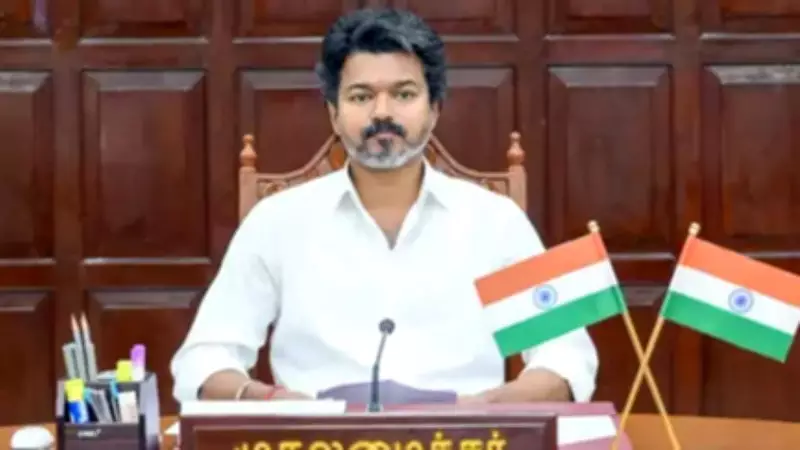
Chennai: Tamil Nadu Chief Minister C Joseph Vijay, in his inaugural address at the NITI Aayog meeting on Thursday, called on the Centre to release Rs 3,284 crore under Samagra Shiksha funds to the state without attaching any conditions. Speaking at the 11th meeting of the Governing Council of the premier policy think tank, Vijay pledged constructive cooperation with the Union government.
Key Demands Raised by CM Vijay
During his address, the chief minister sought exemption from the National Eligibility cum Entrance Test (NEET) for Tamil Nadu, urged steps to secure the release of Tamil Nadu fishermen detained in Sri Lanka, and requested enhanced support for permanent flood mitigation measures. He also proposed that the Thirukkural, an ancient Tamil treatise relevant to modern India's secular values, be declared national literature.
After the meeting, Vijay called on Prime Minister Narendra Modi to discuss key state priorities, including education funds, according to the state government. This was Vijay's second meeting with PM Modi since assuming office as chief minister on May 10, 2026.

Historic Mandate and Cooperation
Participating in the NITI Aayog meeting for the first time as chief minister, Vijay emphasized that the people of Tamil Nadu had given his TVK party a historic mandate based on transparent governance, social justice, inclusive growth, youth empowerment, and balanced development. He reiterated the state's commitment to working constructively with the Union government while safeguarding Tamil Nadu's interests.
Amid global economic uncertainties, Tamil Nadu—India's second-largest economy—continues to show resilience and sustained growth. The state is actively working towards becoming a $1.5 trillion economy by 2036, reflecting a robust economic framework and commitment to building a developed India by 2047.
Youth Empowerment and Skill Development
Vijay outlined his government's plan to provide annual internships with stipends for 5 lakh young people and industry-aligned skill training under the 'Youth Skill and Employment Mission.' He sought Union government support to establish emerging technology skill centers in every district, offering training in Artificial Intelligence, Deep Technology, Cybersecurity, Cloud Computing, Electric Vehicle technology, and Semiconductors.
Opposition to NEET
The chief minister strongly opposed NEET for admission to undergraduate medical and dental courses, stating that rural students and those from disadvantaged families have been adversely affected. He requested that Tamil Nadu be allowed to fill all state quota medical seats—including MBBS, BDS, AYUSH courses—based solely on Class 12 board examination marks.
Education Funds and Policy
Vijay urged the early release of pending Samagra Shiksha Scheme funds amounting to Rs 3,284 crore without conditionalities and without linking to the New Education Policy or three-language policy, emphasizing students' welfare and cooperative federalism.
Poverty Alleviation and Housing
Highlighting inclusive growth and women-led development, Vijay announced a comprehensive poverty-free Tamil Nadu Mission to identify vulnerable families and converge welfare schemes for sustainable livelihoods. He sought financial assistance for affordable housing and requested a second AIIMS for Tamil Nadu at Coimbatore, offering state land for the project.
Women's Safety and Agriculture
On women's safety, Vijay referred to the launch of the 'Singappen' special force in the state police. In agriculture, he highlighted a cooperative crop loan waiver scheme of Rs 2,045 crore benefiting marginal and small farmers through structured debt relief.
Fishermen's Issues
Vijay urged the Government of India to protect traditional fishing rights of Indian fishermen in the Palk Bay, ensure their safety, and secure the release of fishing boats. He also requested urgent diplomatic measures to release Tamil Nadu fishermen apprehended and jailed in Sri Lanka and Pakistan.
The chief minister also requested permission for employment generation under VB-G RAM-G for the state's rural housing schemes, asserting that empowered states make India stronger.






