

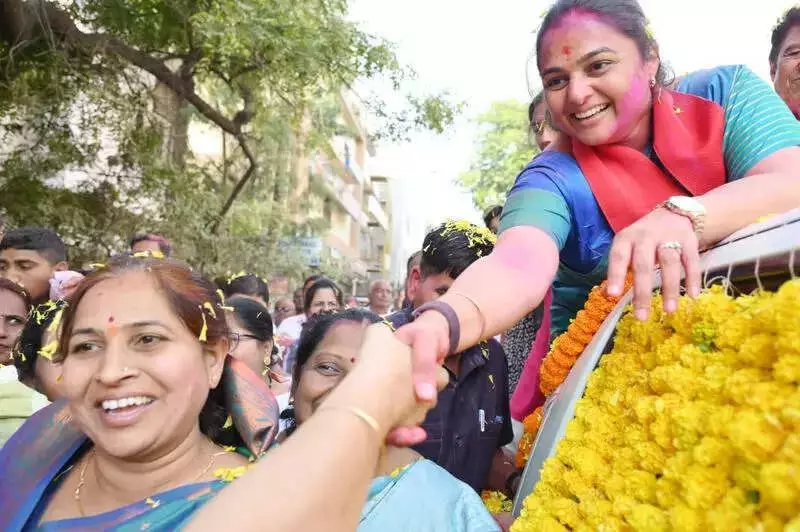
In a significant political development from Nashik, a senior Congress leader has asserted that the party's recent defeat in the Maharashtra assembly elections was merely a temporary setback. This claim follows the impressive victory of the Sangamner Seva Samiti in local polls, which has reignited confidence within the party ranks.
A Victory That Redefines the Narrative
Sachin Gujar, the Congress president for the Ahilyanagar district unit, stated on Monday that the thumping win secured by the Sangamner Seva Samiti has proven the assembly election loss was just an aberration. The Samiti contested using the Lion symbol of the All India Forward Bloc (AIFB). Gujar specifically referenced the shocking defeat of senior Congress leader and former minister Balasaheb Thorat, who was seeking re-election for a ninth term. "Many of us still are unable to digest the defeat," Gujar admitted, adding that the recent public support shows people rejected the opposing forces after testing them for only one year.
The Strategic Alliance and Symbolic Choice
The formation of the Sangamner Seva Samiti was a tactical move. It comprises workers from various political parties allied under the Maharashtra Vikas Aghadi (MVA) umbrella but is led by the Congress. Explaining the choice of symbol, Satyajeet Tambe, an MLC from the Nashik Graduates' Constituency, revealed the search for a common symbol was challenging. "We came across AIFB, started by Netaji Subhash Chandra Bose, with the symbol of a Lion. In four hours, we got in touch with the party concerned, gained their consent, and chose to file nominations on the party symbol," Tambe said. He notably pointed out that the Lion symbol had previously helped Balasaheb Thorat get elected as an independent candidate back in 1985.

Analyzing the Defeat and a New Public Mandate
Tambe provided a candid analysis of the factors behind Thorat's assembly election loss. He acknowledged that besides vote polarisation, schemes like the Ladki Bahin Yojana, the party's overconfidence, and anti-incumbency sentiments played a role. This defeat prompted local leaders to rethink their electoral strategy. A major exercise was undertaken to gauge public opinion, connecting with over 10,000 people both virtually and physically. Following this outreach, Mathili Tambe was elected as the president of the Samiti.
The efforts of the constituency were also highlighted, with Satyajeet Tambe mentioning that since his father, Sudhir Tambe (former MLC), won council elections in 1991, the area has seen consistent development. The council has won prizes worth Rs 27 crore in sectors like clean drinking water supply, plantation, and cleanliness. After extensive town hall meetings, the citizens' demands were encapsulated into an initiative called 'Sangamner 2.0', envisioned as an upgrade for the region's infrastructure and services.
The recent victory, therefore, is not seen as just another electoral win but as a strong indicator that the Congress's core support base remains intact. It has forced a strategic introspection and demonstrated the effectiveness of consolidated opposition efforts under a unifying symbol.






