Congress Legislators Stage Dramatic Protest in Rajasthan Assembly Over Trade Deal
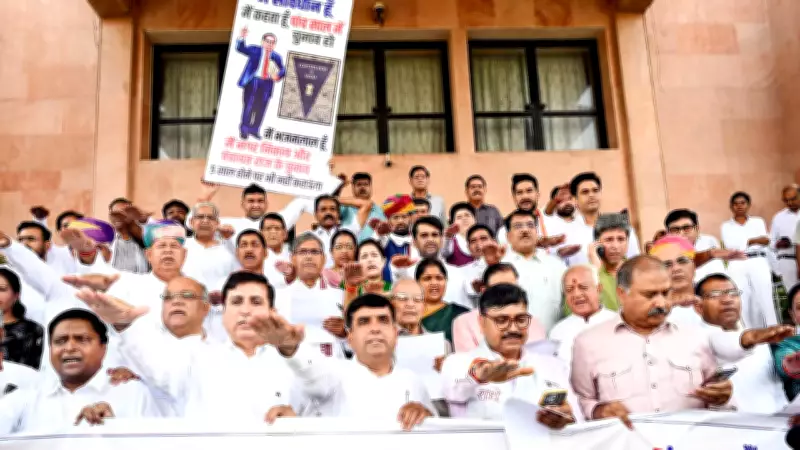
In a striking display of political dissent, Congress MLAs on Thursday staged a vociferous protest inside the Rajasthan Legislative Assembly, directly targeting Prime Minister Narendra Modi over the contentious India–United States trade agreement. The legislators made a bold statement by wearing plain white T-shirts prominently emblazoned with the provocative slogan “PM is compromised,” igniting a heated political confrontation.
Assembly Complex Turns into Protest Venue
The protest unfolded with Congress members assembling near the main entrance of the Assembly complex in Jaipur. They held placards aloft and raised slogans vociferously before proceeding to participate in the day's House proceedings while still dressed in the identical protest T-shirts. This visual demonstration inside the legislative chamber underscored the intensity of the opposition's stance against the central government's trade policies.
Allegations of Harm to Farmers and Traders
Opposition members leveled serious allegations, claiming that the proposed trade pact with the United States would have detrimental effects on India's agricultural sector and small-scale traders. Congress MLA Amin Kagzi addressed reporters outside the Assembly, asserting that “the prime minister stands compromised,” and linking this claim to recent international disclosures that have raised significant concerns. Kagzi further accused the Centre of formulating policies that actively work against the interests of farmers and the nation's economic sovereignty.
Echoing these criticisms, fellow Congress MLA Ramniwas Gawriya delivered a pointed rebuke, stating that while Prime Minister Modi frequently speaks about supporting farmers, the government's concrete decisions and policy directions consistently fail to reflect those public assurances. This sentiment highlights a growing perception gap between governmental rhetoric and actionable outcomes.
Connection to Earlier Youth Congress Demonstration
This legislative protest follows closely on the heels of a related demonstration organized by Indian Youth Congress (IYC) workers on February 20 at the Bharat Mandapam in New Delhi. In that incident, approximately 10 IYC workers were detained by police after briefly raising slogans inside Exhibition Hall No. 5. According to police statements, the protesters had legitimately registered online to attend the event.
Additional Commissioner of Police Devesh Mahla provided details, noting that the detained youth were seen wearing or carrying white T-shirts featuring images of both Prime Minister Narendra Modi and US President Donald Trump. The garments also displayed slogans such as:
- “India–US Trade Deal”
- “Epstein Files”
- “PM is compromised”
These displays reportedly led to heated exchanges with some attendees at the event, indicating the volatile nature of the trade deal discourse. The coordinated nature of these protests—from youth activists in the national capital to elected representatives in a state assembly—suggests a structured opposition campaign gaining momentum across different levels of the political landscape.
Broader Political Implications
The synchronized protests underscore deepening political divisions regarding India's international trade engagements. The Congress party's strategy of using symbolic apparel and coordinated demonstrations reflects an effort to mobilize public opinion against the trade agreement by framing it as compromising national interests. As debates over economic sovereignty versus global integration intensify, such protests are likely to influence both parliamentary discourse and public perception in the coming months.
The visual symbolism of the white T-shirts, combined with direct allegations against the Prime Minister, represents a significant escalation in political rhetoric. This development occurs within the broader context of ongoing negotiations and public scrutiny of international trade agreements, making the Rajasthan Assembly protest a notable moment in contemporary Indian political theater.