

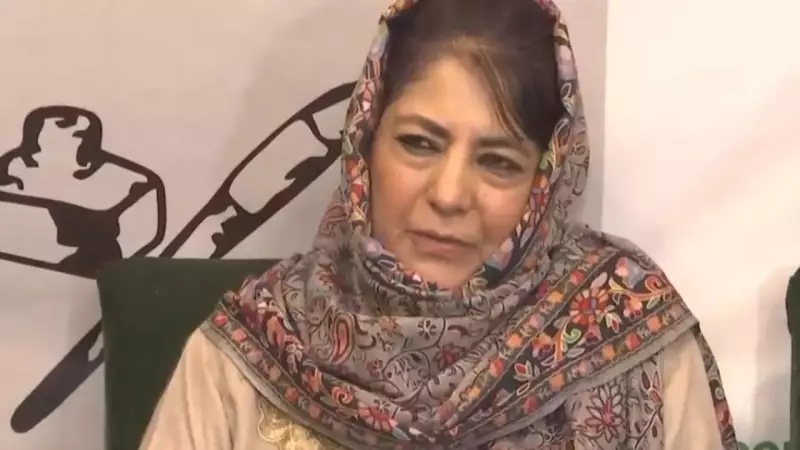
The Jammu and Kashmir High Court delivered a significant verdict on Tuesday, dismissing a public interest litigation (PIL) filed by former Chief Minister and Peoples Democratic Party (PDP) president Mehbooba Mufti. The petition sought the transfer of Kashmiri political prisoners currently held in various jails across India to detention facilities within the union territory.
Court's Strong Rebuke on Political Motives
In a strongly worded judgment, a division bench comprising Chief Justice Arun Palli and Justice Rajnesh Oswal rejected the plea. The bench described the PIL as "an instrument for advancing partisan or political agendas" and stated that the court cannot be transformed into a political platform. The judges were unequivocal in their observation that such petitions should not be used as a mechanism for gaining political leverage or for conducting electoral campaigns.
The court explicitly noted that it appeared the petition was initiated by Mehbooba Mufti "for the explicit purpose of garnering political advantage and positioning herself as a crusader of justice for a particular demographic." Consequently, the bench dismissed the PIL, labeling it as "misconceived."

Legal Grounds for Dismissal
The bench outlined clear legal reasons for its decision. It pointed out that the petitioner's request was legally unsustainable because no specific transfer orders concerning the prisoners had been challenged in the plea. Furthermore, the court noted that no such orders were even presented on record for its consideration. This lack of specific legal challenge formed a core part of the rationale for dismissing the case.
The judgment reinforces the judiciary's stance on the scope and purpose of Public Interest Litigation. The bench emphasized that PILs are not meant to serve as tools for political campaigning or for individuals to score political points. This ruling sets a precedent regarding the filing of petitions that may have underlying political objectives rather than purely legal or humanitarian grounds.
Implications and Aftermath
The dismissal leaves unchanged the current situation of the Kashmiri political prisoners who remain lodged in jails outside Jammu and Kashmir. The court's decision is seen as a setback for Mehbooba Mufti and the PDP, who have often raised the issue of detainees. The strong language used by the High Court bench highlights the ongoing tension between political narratives and judicial processes in the region.
This verdict is likely to influence how similar petitions are framed and filed in the future, stressing the need for concrete legal challenges rather than broad political appeals. The focus remains on the legal merits of a case, with the judiciary asserting its role as an arbiter of law, not a forum for political discourse.






