The political landscape for Goa's upcoming Zilla Panchayat (ZP) elections has transformed into a complex and multi-layered puzzle. The reconfiguration of alliances, the entry of new political parties, and instances of friendly fights have created a scenario that is challenging to predict. This electoral battle is widely seen as a crucial litmus test for all political forces, setting the tone for the larger state assembly elections due in 2027.
Alliances and Seat Distribution: A Shift from 2020
The current electoral dynamics mark a significant shift from the last ZP polls in 2020. Back then, parties contested independently, with the BJP securing a comfortable victory, winning 14 of 24 seats in South Goa and 19 of 25 in North Goa. This was Chief Minister Pramod Sawant's first major electoral test after assuming office.
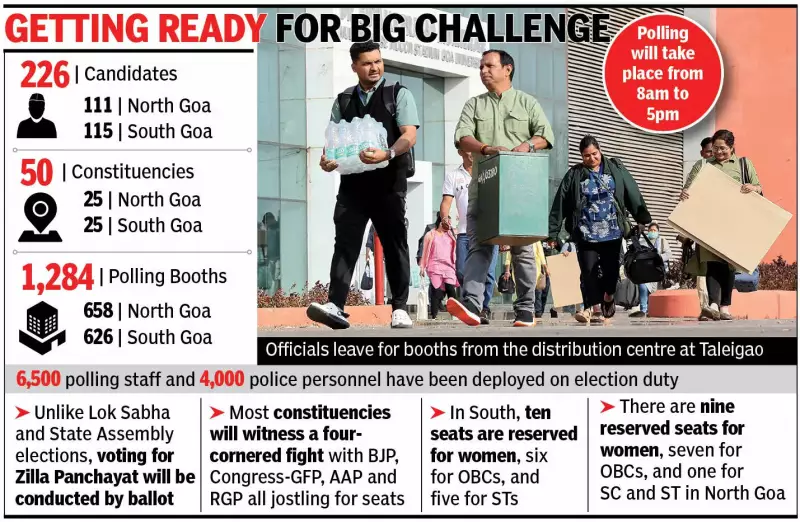
This time, alliances are in play. The ruling BJP has forged a pact with the Maharashtrawadi Gomantak Party (MGP). On the other side, the Congress has allied with the Goa Forward Party (GFP). Meanwhile, the Aam Aadmi Party (AAP) and the Revolutionary Goans (RG) are contesting independently. This has resulted in intense four-cornered contests in nearly 40 of the 50 constituencies.

The opposition's hope for a united front fractured during the nomination process. While Congress successfully allied with GFP, a last-minute seat-sharing disagreement prevented a partnership with the Revolutionary Goans.
The Numbers Game: Who is Contesting Where?
Voters will elect 50 Zilla Panchayat members from a pool of 226 candidates across 25 constituencies each in North and South Goa. A total of 8.6 lakh voters are eligible to cast their ballots on Saturday.
The BJP is contesting 40 seats, leaving three for ally MGP and seven for independent candidates. The Congress-GFP alliance sees Congress contesting 36 seats and GFP nine, with friendly fights in two North Goa constituencies: Morjim and Corlim. The AAP is contesting 42 seats and supporting independents, while the RG is trying to make its mark in 30 constituencies.
In several areas, parties have fielded candidates against their allies, while some who lost recent assembly elections are backing independents to maintain political relevance.
Key Battlegrounds: Salcete, Quepem, and Canacona
The taluka of Salcete, with its nine ZP constituencies, is witnessing a particularly intense three-cornered fight. With a marginal BJP presence in this Catholic-dominated region, the main contest is between the Congress-GFP alliance, AAP, and independents. RG is contesting only four seats here. A total of 42 candidates are in the fray across Salcete's constituencies: Raia, Nuvem, Colva, Benaulim, Davorlim, Velim, Curtorim, Guirdolim, and Navelim.
Given AAP's two sitting MLAs from Velim and Benaulim, a close battle is anticipated between the party and Congress candidates in these coastal segments. Political observers note that with local influencers holding sway and multiple parties potentially splitting the anti-BJP vote, the outcome in Salcete remains highly uncertain.
In Quepem, former MLA Chandrakant Kavlekar is campaigning vigorously to recover ground lost to Congress's Altone D'Costa. In Shiroda, Water Resources Minister Subhash Shirodkar’s daughter, Gauri (BJP), is locked in a four-cornered contest against AAP, RG, Congress, and an independent. Meanwhile, in Canacona's Poinginuim and Cola constituencies, the BJP faces a stiff challenge from the Congress-GFP alliance.
Stakes and Statements
Chief Minister Pramod Sawant has emphasized the importance of these elections for rural development, urging a high voter turnout. He stated that the Zilla Panchayats would be linked to the rural development agency to boost local economic activities.
As Goa votes this Saturday, the results will not only determine the composition of the local governing bodies but also provide a critical snapshot of the evolving political equations in the state, offering a preview of the larger battles to come in 2027.