

Hyderabad Assembly Greenlights Metro Rail Takeover and Massive Expansion
The Telangana Legislative Assembly, in a significant move on Saturday, adopted a resolution introduced by Chief Minister A. Revanth Reddy to take over the 69-kilometer Phase-1 of the Hyderabad Metro rail from Larsen & Toubro (L&T) and proceed with a major expansion plan. The resolution, which includes Phase-IIA and Phase-IIB covering 76.4 kilometers and 86.1 kilometers respectively, was passed amidst vocal protests from opposition benches.
Resolution Tabled Amidst Opposition Protests
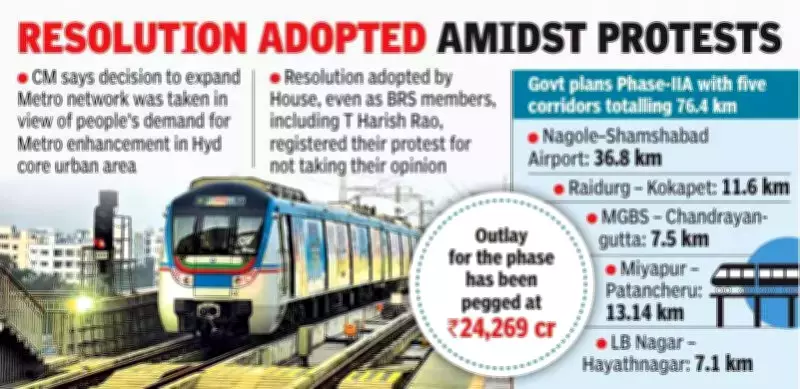
While presenting the resolution, Chief Minister Revanth Reddy emphasized that the decision to expand the Metro network was driven by public demand for enhanced connectivity in Hyderabad's core urban areas. The House adopted the resolution, even as members of the Bharat Rashtra Samithi (BRS), including T. Harish Rao, protested the government's failure to consult them on the matter.
Prior to the CM's tabling of the resolution, Legislative Affairs Minister D. Sridhar Babu outlined the details on behalf of Revanth Reddy. He explained that the Phase-1 project, encompassing three corridors—Nagole-Raidurg, JBS-MGBS, and Miyapur-LB Nagar—was awarded to L&T in 2010 under a 35-year public-private partnership (PPP) model. Commercial operations commenced in stages from November 2017 to February 2020.

Decline in Metro Ranking Spurs Expansion
Minister Sridhar Babu highlighted that despite Hyderabad's rapid growth, the Metro network had not been expanded, causing the city to slip from second to ninth position in India in terms of Metro rail length. To regain momentum, the government has planned Phase-IIA, which includes five corridors totaling 76.4 kilometers: Nagole–Shamshabad Airport (36.8 km), Raidurg–Kokapet (11.6 km), MGBS–Chandrayangutta (7.5 km), Miyapur–Patancheru (13.14 km), and LB Nagar–Hayathnagar (7.1 km). The estimated outlay for this phase is 24,269 crore rupees.
Phase-IIB proposes three corridors covering 86.1 kilometers: Shamshabad Airport–Bharat Future City (39.6 km), JBS–Medchal (24.5 km), and JBS–Shamirpet (22 km), with a projected cost of 19,579 crore rupees. The combined blueprint for 162.5 kilometers of new lines was submitted to the Union Ministry of Housing and Urban Affairs on November 4, 2024, seeking clearance as a joint venture between the central and state governments.
Central Government's Integration Demand and L&T's Exit
The central government insisted on seamless operational integration with the privately operated Phase-1, as four of the five Phase-IIA lines are continuations of existing routes. Minister Sridhar Babu noted that the Union government had requested L&T to participate in Phase-II as an equity partner, but the company declined, citing corporate policy. Instead, L&T offered to exit Phase-1 if the government assumed its 13,000 crore rupee debt and compensated its equity.
In response, the state cabinet approved the takeover on February 23, 2026. The council of ministers, in a meeting on March 23, authorized the Hyderabad Metro Rail Limited (HMRL) to take over L&T's debt and equity for no more than 15,000 crore rupees, following due legal processes by April 30.
Strategic Implications for Urban Development
This resolution marks a pivotal shift in Hyderabad's urban infrastructure strategy, transitioning from a PPP model to greater government control. The expansion aims to significantly enhance public transportation, reduce traffic congestion, and support the city's economic growth. The adoption of the resolution underscores the state government's commitment to revitalizing the Metro system and positioning Hyderabad as a leader in sustainable urban mobility.






