

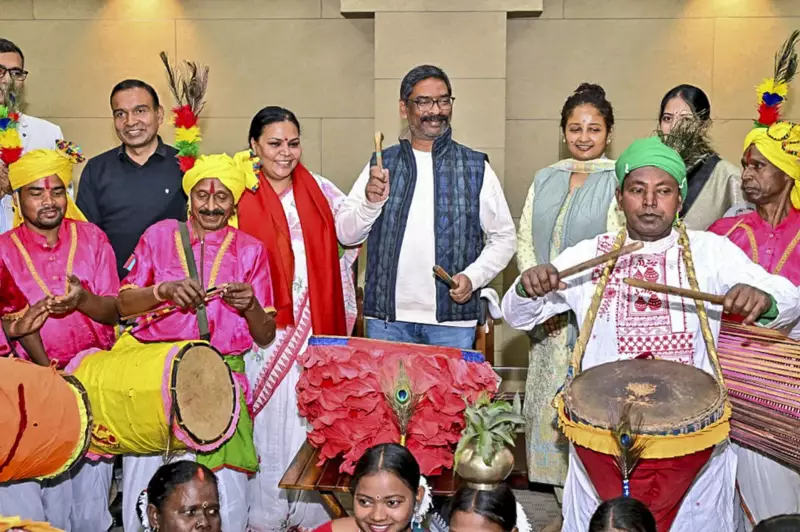
The Hemant Soren-led cabinet in Jharkhand approved the long-awaited rules for the Panchayats (Extension to Scheduled Areas) Act, or PESA, on Tuesday, sparking widespread celebrations across Ranchi on Wednesday, which was observed as National PESA Day. The ruling alliance and tribal communities hailed the move as a historic step towards empowering Gram Sabhas and protecting tribal rights.
Celebrations and Gratitude Mark the Day
Scores of tribal community members and civil society representatives, who had gathered at Audrey House for a two-day self-governance festival, took out a march to Chief Minister Hemant Soren's official residence. The procession aimed to express their gratitude for the government's decision. State Rural Development Minister Deepika Pandey Singh, who spearheaded the rules' formulation over the past year, joined the celebratory march.
Minister Singh emphasized that this action fulfills a key promise made by the grand-alliance government during the 2024 assembly polls. "This decision is not just a law, but a revolutionary step to provide constitutional guarantee of the real rights, respect and self-governance to the Gram Sabhas," she stated. She added that through these rules, tribal society will gain decisive authority over their water, forests, land, and local resources, thereby strengthening grassroots democracy.

A Long-Awaited Implementation
Former minister and Lohardaga MLA Rameshwar Oraon also hosted a large celebratory gathering at his Bariatu residence. His daughter, Nesha Oraon, an IRS officer formerly posted in the Panchayat Raj department, participated enthusiastically, beating traditional drums (dhol-nagadas) and playing with floral gulal.
She highlighted the protracted struggle for PESA in Jharkhand. "For the first time since the state's formation in 2000, implementation of PESA rules will now pave way for a strong foundation for protecting the traditions, culture, social systems and religious beliefs of tribal society," she remarked. She pointed out that the PESA law in Jharkhand had been stuck in legal disputes and judicial processes for years. The drafting of rules began only after the Supreme Court's final verdict in favor of the PESA law in 2018, finally culminating in the cabinet's approval after overcoming all obstacles.
Political Reactions and Counterclaims
The ruling Jharkhand Mukti Morcha (JMM) seized the moment to criticize the opposition BJP. JMM's central general secretary, Supriyo Bhattacharjee, addressed the media, questioning why successive BJP governments in the state since 2000 had failed to implement PESA. "BJP and all its past chief ministers must answer why did they not work towards it so far? Hemant govt has delivered what it promised," he said. He asserted that villages will now chart their own future, which the state government will follow. The JMM's ally, the RJD, also welcomed the step, labeling it "historic."
However, the opposition BJP raised questions about the transparency of the process. The party's vice president, Aarti Kujur, asked why the government had not made the approved rules public even 24 hours after the cabinet meeting. "Public and tribal society have the right to see what actually the rules are before calling it as 'historic'," she argued. She claimed that the state government was compelled to act only after the Jharkhand High Court came down heavily on it regarding the delay in framing the PESA rules.
The passage of the PESA rules marks a significant political and administrative milestone in Jharkhand, setting the stage for a new era of tribal self-governance, albeit amid continued political debate over its execution and details.






