

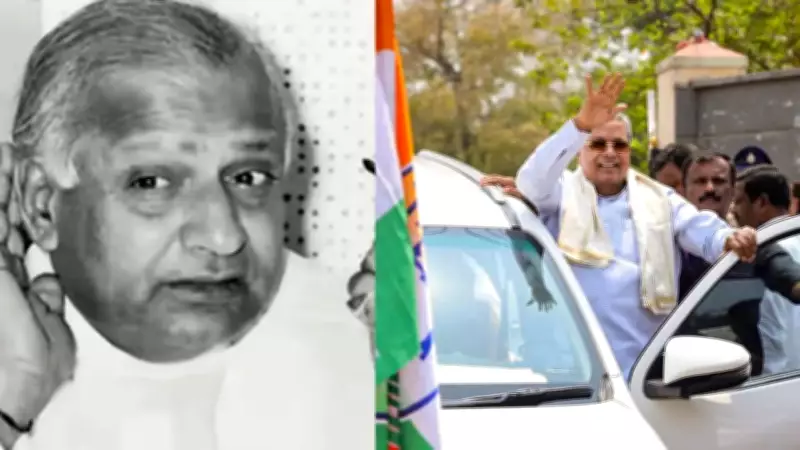
BENGALURU: Karnataka's political landscape has been marked by frequent instability, resignations, coalition collapses, and leadership changes. Since 1956, only three chief ministers — S Nijalingappa (1962-68), D Devaraj Urs (1972-77), and Siddaramaiah (2013-18) — have completed their full five-year tenures.
1958: S Nijalingappa
The veteran Congressman assumed charge as Chief Minister after the unification of Mysore state. However, a rebellion by Lingayat MLAs within the Congress party disrupted his administration. The Congress high command sided with the rebels, forcing Nijalingappa to resign well before completing his term. He was succeeded by BD Jatti.
1971: Veerendra Patil
Following a split in the Congress party in 1969, Lingayat representative Veerendra Patil, who aligned with the Congress (Organisation) faction, became Chief Minister. However, after Indira Gandhi secured a landslide victory in the 1971 general elections, several ministers and MLAs defected to her faction. The government lost its majority and collapsed, paving the way for the first imposition of President's Rule in Karnataka.

1980: D Devaraj Urs
Widely regarded as a mass leader of backward communities, Urs became Chief Minister for a second term. After falling out with Indira Gandhi, Urs formed his own faction, Congress (Urs). When Indira Gandhi returned to power at the Centre in 1980, several MLAs from Urs' faction shifted allegiance to the Indira-led Congress. Urs' government lost its majority, and he resigned. He was succeeded by R Gundu Rao.
1988: Ramakrishna Hegde
Hegde was Karnataka's first non-Congress Chief Minister but resigned amid allegations of phone tapping involving opposition leaders and dissenters in his own party. Claiming moral responsibility, Hegde stepped down midway through his term. SR Bommai succeeded him.
1990: Veerendra Patil
The Congress secured a thumping win in the 1989 elections, and Veerendra Patil was again chosen as Chief Minister. However, within a year, communal clashes in Channapatna and Davanagere triggered a major law-and-order crisis. Patil was recovering from paralysis in the hospital. During a visit to Karnataka, Congress president Rajiv Gandhi announced at Bengaluru airport that Patil would be replaced. S Bangarappa was made Chief Minister.
1992: S Bangarappa
Bangarappa's tenure was marred by allegations of corruption and internal rebellion. Dissidents led by senior functionary M Veerappa Moily openly campaigned against him. Alarmed by the turmoil, the Congress asked Bangarappa to resign and appointed Veerappa Moily as Chief Minister.
1996: HD Deve Gowda
After the Janata Dal defeated the Congress in 1994, HD Deve Gowda was sworn in as Chief Minister. However, a fractured verdict in the 1996 general elections saw Gowda chosen as Prime Minister. He resigned as Chief Minister, paving the way for JH Patel to take charge.
2006: N Dharam Singh
Following a fractured mandate in the 2004 assembly polls, the Congress formed a coalition government with the JD(S), led by Dharam Singh. In 2006, JD(S) members led by HD Kumaraswamy withdrew support and aligned with the BJP. Singh resigned, paving the way for Kumaraswamy to become Chief Minister.
2007: HD Kumaraswamy
After completing 20 months in office, Kumaraswamy refused to transfer authority to the BJP as per a coalition agreement. He resigned amid turmoil, following which BS Yediyurappa was sworn in as Chief Minister. However, Yediyurappa's government lasted only seven days after the JD(S) withdrew support.
2008–2013: BS Yediyurappa, DV Sadananda Gowda, Jagadish Shettar
The BJP formed its first government in south India in 2008, with Yediyurappa as Chief Minister. When the Lokayukta registered an FIR against him in the illegal mining case in 2011, the BJP high command asked him to quit. Sadananda Gowda succeeded him but resigned within 11 months due to resistance from his own party legislators. Jagadish Shettar was Chief Minister for the final year of the government's term.

2019–2023: HD Kumaraswamy, BS Yediyurappa, Basavaraj Bommai
Following a hung verdict in 2018, the Congress again partnered with the JD(S), and Kumaraswamy took oath as Chief Minister. Rebellion and differences triggered the resignation of 17 MLAs, and the government lost its majority a year later. Yediyurappa returned as Chief Minister for the fourth time, but he too was asked to step down in 2021, and the BJP's high command replaced him with Basavaraj Bommai.
You can also check: Gold Rate in Bengaluru, Silver Rate in Bengaluru, Bank Holidays in Bengaluru, Public Holidays in Bengaluru, Bengaluru AQI, Weather in Bengaluru, Petrol Price in Bengaluru, Diesel Price in Bengaluru, CNG Price in Bengaluru, LPG Price in Bengaluru.
About the Author: Niranjan Kaggere is a Senior Assistant Editor with over 20 years of experience, adept at writing and reporting on a wide range of issues affecting society. Passionate about reporting on environment, wildlife, energy, history, and the state secretariat, his news reports deliver in-depth, engaging content to diverse audiences. In his free time, Niranjan sets out to forests and farms, exploring the natural world.





