

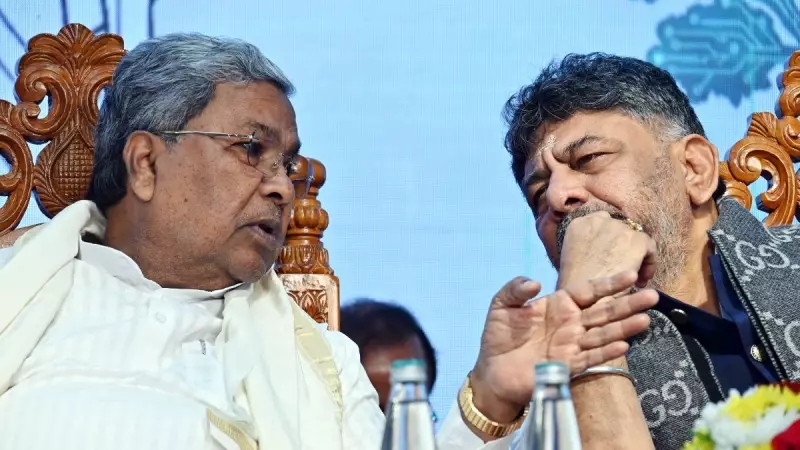
The simmering power struggle within the Karnataka Congress unit has reached a critical juncture, with the party's national president, Mallikarjun Kharge, indicating a potential high-level intervention from Delhi. The internal conflict, primarily between Chief Minister Siddaramaiah and Deputy Chief Minister DK Shivakumar, has prompted the central leadership to consider summoning both leaders to the national capital to resolve the ongoing friction.
Kharge's Statement on the Leadership Dispute
Congress President Mallikarjun Kharge directly addressed the media speculation surrounding the discord in Karnataka. He confirmed that the party is closely monitoring the situation. "If needed, we will call both Siddaramaiah and Shivakumar to Delhi," Kharge stated, underscoring the party high command's readiness to step in. This remark highlights the seriousness with which the national leadership views the internal tensions that threaten to destabilize the party's only government in South India.
The statement came amidst persistent reports of disagreements between the two top leaders over administrative control, portfolio allocations, and political appointments. While both leaders have publicly denied any rift, their supporters and associated factions have been engaged in a war of words, creating an atmosphere of unease within the state government.

The Roots of the Rivalry
The Karnataka power tussle is not a new phenomenon but a continuation of a long-standing political dynamic. DK Shivakumar, the state party president and a Vokkaliga leader, is widely seen as the architect of the Congress's victory in the 2023 assembly elections. On the other hand, Siddaramaiah, a former chief minister and a prominent AHINDA (Kannada acronym for minorities, backward classes, and Dalits) face, commands a significant mass base.
The current arrangement of Siddaramaiah as Chief Minister and Shivakumar as his sole deputy was a compromise brokered by the central leadership after the elections. However, the sharing of power and influence has remained a contentious issue. Key points of friction include:
- Control over key ministerial portfolios and bureaucratic postings.
- Political credit for government schemes and development projects.
- Strategies for the upcoming Lok Sabha elections and constituency management.
The situation demands delicate handling by the Congress high command, as any misstep could alienate crucial caste constituencies and weaken the party's position ahead of the national polls.
Implications for the Congress and the State
The public airing of this internal dispute has significant consequences. Firstly, it diverts the government's attention from governance and policy implementation to managing political firefighting. This could impact the administration's efficiency and its public image.
Secondly, the Congress leadership faces a strategic challenge. A forceful diktat from Delhi might temporarily quell the rebellion but could breed resentment. A softer, consultative approach might be seen as a sign of weakness. Kharge's statement is a clear warning that the party's central apparatus is losing patience and is prepared to enforce discipline.
For the state of Karnataka, prolonged instability is detrimental to its developmental agenda. Investors and the bureaucracy often become cautious in an environment of political uncertainty. The opposition BJP is likely to capitalize on this perceived disarray within the ruling party to mount its critique.
The potential summoning of Siddaramaiah and Shivakumar to Delhi is aimed at presenting a united face before the crucial parliamentary elections. The Congress cannot afford a public feud in its most significant southern stronghold. The outcome of this Delhi intervention, if it materializes, will be crucial in determining the stability of the Karnataka government and the Congress party's cohesion in the run-up to 2024.






