

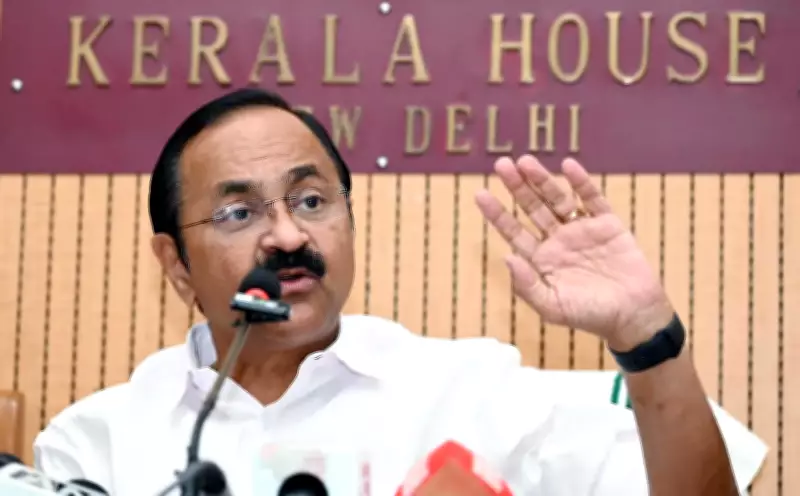
Thiruvananthapuram: In a significant administrative course correction under the new United Democratic Front (UDF) government, Chief Minister V D Satheesan on Monday directed Kerala's top bureaucracy to rethink outdated laws, reduce decision-making delays, improve inter-departmental coordination, and make governance more responsive to evolving economic and social realities.
The directives were issued during a nearly two-hour meeting attended by IAS officers of the rank of special secretary and above. The session began with departmental secretaries outlining their departments' functioning and challenges, after which the Chief Minister laid out his expectations from the administrative machinery.
Revisiting Outdated Laws
One of Satheesan's key messages was the need to revisit several laws that have remained largely untouched despite repeated calls for reform. Aligned with the UDF's declared policy direction, he stressed the importance of timely and relevant amendments to legislations such as the Plantation Act, Land Reforms Act, and Paddy and Wetland Act. He asked departmental secretaries to present concrete suggestions on reforms required to make these laws more relevant to present-day realities.

Encouraging Decision-Making and Coordination
To encourage decision-making within the bureaucracy, Satheesan assured officers that the government would protect officials who take decisions in good faith as part of their official duties. He also emphasized the need for stronger coordination among departments, noting that a lack of coordination often slows down governance and project execution. He reiterated that all proposals involving financial liabilities for the state must necessarily be routed through the finance department.
In what could become one of the government's major administrative reform initiatives, Satheesan proposed reducing the multiple layers involved in file processing. He announced that an expert team of officers would soon be constituted to recommend ways to streamline file movement and speed up decision-making.
Addressing Land Acquisition Delays
The Chief Minister identified delays in land acquisition as one of the biggest reasons behind cost overruns in public projects. Delayed acquisition, he noted, often leads to significant escalation in project costs and financial leakages. He also raised concerns over the state's dependence on external agencies for preparing detailed project reports (DPRs) and said the government should build stronger in-house technical capacities.
Monitoring Litigation and Central Schemes
Satheesan also sought closer monitoring of government litigation. He asked departmental secretaries to ensure that government pleaders keep them periodically informed about the status of court cases involving their departments. Additionally, he directed secretaries to closely monitor centrally sponsored schemes and undertake a review of missions, technical support units, external agencies, and other special-purpose bodies that continue to function even after their original objectives have been achieved.
Operational Concerns Raised by Officers
Several secretaries used the meeting to explain not only policy bottlenecks but also operational shortcomings within their departments. Issues relating to office infrastructure and the availability of basic facilities for senior officers were also raised, with the Chief Minister assuring that such concerns would be looked into. Some of the concerns aired reflected the everyday frustrations of the state's top bureaucracy. One senior officer is understood to have flagged delays in the settlement of medical reimbursement claims relating to treatment in a private hospital, while others raised the issue of inadequate availability of official vehicles for IAS officers.
Intellectual Displays and Reactions
While most officers confined themselves to departmental issues, some appeared eager to display their intellectual range before the new Chief Minister. One officer reportedly offered an extended observation that Kerala's planning board was following a 'Russian system' of planning, a remark that left a few participants privately wondering whether the discussion was centered on governance reforms in contemporary Kerala or economic theories from another era.

About the Author
KP Sai Kiran is an Assistant Editor with The Times of India, based in the Thiruvananthapuram bureau, where he has been working since 2011. Over the years, he has reported from New Delhi and Kerala, covering subjects ranging from crime and courts to governance and public policy.





