

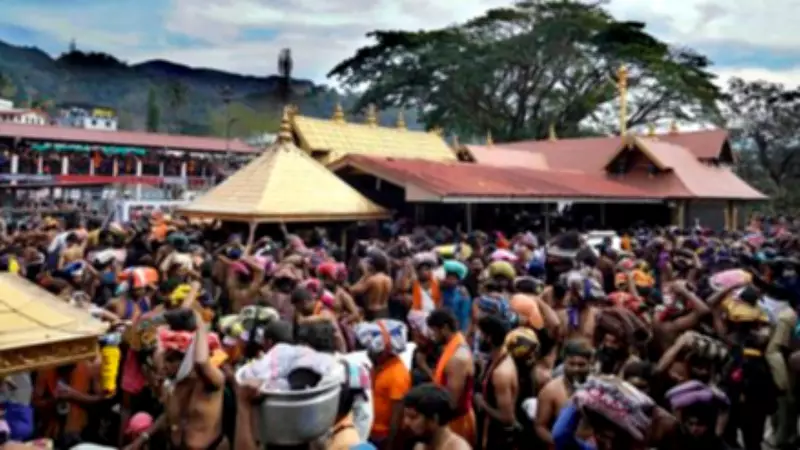
Kerala Minister Reaffirms Government's 2007 Sabarimala Position
Kerala minister VN Vasavan on Saturday declared that the CPM-led LDF government continues to stand firmly by the affidavit it submitted to the Supreme Court in 2007 regarding the contentious Sabarimala women's entry issue. Simultaneously, he launched a sharp accusation against the Bharatiya Janata Party (BJP), holding it responsible for the legal proceedings that culminated in the landmark 2018 verdict permitting women of menstruating age to enter the revered hill shrine.
Government's Unchanged Stance on Ritualistic Expertise
Responding to media inquiries about the affidavit to be presented before a nine-judge Constitution bench of the Supreme Court, Minister Vasavan clarified that the state government's position remains entirely unchanged. He emphasized, as reported by the Press Trust of India (PTI), that the question of allowing women of menstruating age into the Sabarimala temple should be determined exclusively by experts well-versed in ritualistic matters and traditions.
"We had explicitly stated in our 2007 affidavit that this sensitive matter should be decided by experts in ritualistic traditions. We continue to maintain that exact stand without any alteration," the minister asserted during his statement.

Vasavan further clarified that the Supreme Court has not currently sought the Kerala government's direct position on the specific issue of women's entry into Sabarimala. Instead, the apex court has requested clarification on certain broader constitutional questions related to the case. The state government has entrusted the Advocate General and a team of constitutional experts to prepare and submit its detailed response before the court.
Accusations Against BJP and Legal Battle Origins
In a significant political charge, Minister Vasavan blamed lawyers associated with the BJP for initiating the legal battle that eventually led to the Supreme Court's 2018 verdict. "It was young lawyers linked to the BJP who originally approached the Supreme Court and later hailed the verdict as historic. Now, curiously, they are taking a completely different stand," he alleged, highlighting a perceived inconsistency in the BJP's position.
The minister also firmly rejected allegations that the LDF government had shown any special enthusiasm or interest in facilitating women's entry into the temple following the 2018 ruling. He stated that the state administration had merely fulfilled its legal obligation by implementing the Supreme Court's order. "If the apex court delivers a verdict, how can we possibly oppose it? The women's entry was solely the decision of the Supreme Court," Vasavan explained, distancing the government from direct involvement in the judicial outcome.
Political Reactions and Broader Context
The 2018 Supreme Court verdict sparked massive and widespread protests across Kerala, with the issue deeply polarizing public opinion. The Supreme Court is presently hearing a series of petitions seeking a comprehensive review of that controversial verdict.
Echoing the government's stance, CPM general secretary MA Baby stated that the LDF government implemented the court's directive in 2018 strictly because it was legally bound to do so. "At that time, there was hardly any political party that did not welcome the verdict. Later, some of them changed their stand," he noted, adding that the court itself is now reconsidering the earlier judgment.
Baby also suggested that when complex issues involving religious traditions are examined, the perspectives of ritual experts and social reformers who are acceptable to the general public should be given due consideration.
BJP's Counterclaims and Demands
On the opposing side, BJP state general secretary MT Ramesh claimed that the Kerala government's fresh affidavit essentially amounts to an admission of its earlier mistake. "The BJP demands that the state government issue a formal apology to the Ayyappa devotees," he declared, questioning why the government had altered its stance after strongly supporting reforms in 2018.

Ramesh further alleged that more than 10,000 cases were registered against individuals who participated in protests during the intense agitation over the Sabarimala issue. He demanded that these cases be immediately withdrawn in light of the government's newly articulated position, arguing that it reflects a shift that should benefit the protesters.
The ongoing legal and political debate underscores the enduring sensitivity of the Sabarimala issue, blending constitutional questions, religious traditions, and partisan politics in a state known for its progressive social movements.





