

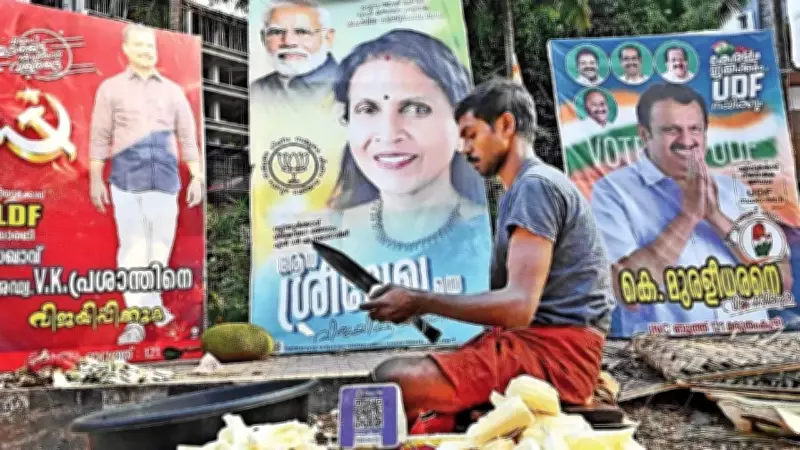
Vattiyoorkavu's 2026 Assembly Election: A Crucible of Political Change
In the rapidly urbanizing constituency of Vattiyoorkavu, the upcoming 2026 Assembly election is emerging as far more than a standard political race. It represents a compelling convergence of personal comebacks, governance records, and ambitious breakthroughs, setting the stage for a transformative battle that could redefine Kerala's urban electoral landscape.
The Contenders: Three Distinct Narratives Collide
For K Muraleedharan of the Congress, this election is a pivotal moment of redemption. A former two-term MLA from Vattiyoorkavu, he returns after facing defeats in Nemom and Thrissur, aiming to reclaim his home turf. Often deployed by his party to counter BJP advances, Muraleedharan now fights a personal campaign, framed as a homecoming by supporters but viewed by critics as a final opportunity to revive his political career.
Opposing him is the incumbent, V K Prasanth of the Left Democratic Front (LDF), whose tenure mirrors Vattiyoorkavu's own evolution. First elected in a bypoll following Muraleedharan's move to the Lok Sabha, Prasanth has cultivated an image of accessibility and development, citing over Rs 1,000 crore invested in infrastructure projects like road widening and welfare schemes. He positions himself as the candidate of continuity and tangible progress.

Complicating this duel is the entry of R Sreelekha, the NDA candidate and Kerala's first woman Director General of Police. Her candidacy brings administrative credibility and a non-traditional appeal, signaling the BJP's growing confidence in urban Kerala, backed by recent electoral gains that have reshaped the constituency's dynamics.
Electoral Shifts: From Bipolar to Triangular Politics
The political landscape in Vattiyoorkavu has undergone a significant transformation. In the 2024 Lok Sabha election, NDA candidate Rajeev Chandrasekhar led in the Vattiyoorkavu segment with 53,025 votes, surpassing UDF's Shashi Tharoor at 44,863 and LDF's Pannian Raveendran at 28,336. This result underscores a shift that seemed unlikely a decade ago.
At the local level, the BJP has strengthened its presence, winning 10 of the 18 corporation wards within the constituency, compared to six for the LDF and only three for the UDF. Having secured second place in both the 2016 and 2021 Assembly elections, what was once a straightforward two-party contest has now evolved into a competitive three-way race, reflecting broader changes in Kerala's urban politics.
Voter Sentiments: Development Versus Desire for Change
Vattiyoorkavu is a diverse urban seat, with a Hindu-majority population of 77%, alongside significant Christian (13–14%) and Muslim (7–8%) minorities. While caste and community factors subtly influence decisions, the electorate is increasingly driven by civic issues and governance performance.
On the ground, opinions are split. Sunny R. Nair from Kodunganoor highlights progress: "The long-pending development of Vattiyoorkavu junction is finally materializing. After years of delays in land acquisition and compensation, these issues have been resolved, and the last five years have seen real improvements in roads and basic infrastructure."
In contrast, Daniel Thomas of Nettayam advocates for change: "If a UDF government comes to power, Vattiyoorkavu will likely have a minister, bringing direct benefits to the constituency. People are aware of this, and the vote will be for change."
Implications: A Bellwether for Kerala's Urban Future
This election is a microcosm of larger political trends in Kerala. For the Congress, it is a fight to reclaim lost ground and reassert influence. For the Left, it is a defense of their governance record and development claims. For the BJP, it represents a critical opportunity to break through in urban Kerala and expand their footprint beyond traditional strongholds.

As campaigns intensify across Vattiyoorkavu's bustling streets and quiet neighborhoods, one thing is clear: no party can consider this a safe seat anymore. The outcome will be shaped by historical legacies, current performances, and emerging ambitions, potentially signaling the future direction of urban politics in the state. This triangular contest is not just about winning an Assembly seat; it is about setting a precedent for how Kerala's evolving urban electorate engages with power and policy.





