

A state of fear and mourning grips the border villages of West Singhbhum district in Jharkhand as a rogue elephant, responsible for a trail of death, remains on the loose. The pachyderm, which has killed 20 people including a forester from Bengal, has now slipped into neighboring Odisha, evading capture despite intensive tracking efforts by forest departments of both states.
Panic and Grief in the Border Villages
The terror unleashed by the musth elephant has left an indelible mark on approximately 15 villages near the Benisagar forest in the Majhgaon block. An uneasy calm prevails, punctuated by the palpable fear among residents. "Not only in the dark but even during the day, we are afraid of the elephant. It gives us goosebumps when we think about the elephant’s violent run," shared Sanju, the widow of Prakash Tanti, 40, who was trampled to death last Friday when he went to attend to nature's call.
The horror stories are recounted with fumbling voices and terrified expressions. The impact is severe enough that villagers have stopped tending their fields and avoid entering the forest to collect firewood, crippling their daily lives and livelihoods. These communities are predominantly hand-to-mouth, dependent on small paddy fields, forest produce, and government ration.

Administrative Failure and Villagers' Anger
Anger is mounting against the administration and forest officials for their inability to control the situation. The primary grievance is the lack of basic safety infrastructure like high-mast solar lights, forcing villagers to rely on fire torches and crackers to scare the elephant away in the dark. Pratap Chandra, the mukhiya of Kharpos panchayat, expressed the collective frustration: "Over three years went by demanding solar lights in the villages, but the administration is sitting on it with a deaf ear."
Majhgaon BDO Vijay Ratan Tirkiey acknowledged the issue, stating he had inspected remote areas and sent a proposal for installing lighting at 10 places. Meanwhile, the search for safe shelter is another challenge. Majhgaon panchayat mukhiya Abha Madhu Dhan highlighted that while fear drives people to seek safer places, there is little official support. Currently, about 10 villagers are temporarily staying at her house.
Inter-State Chase and High-Tech Tracking
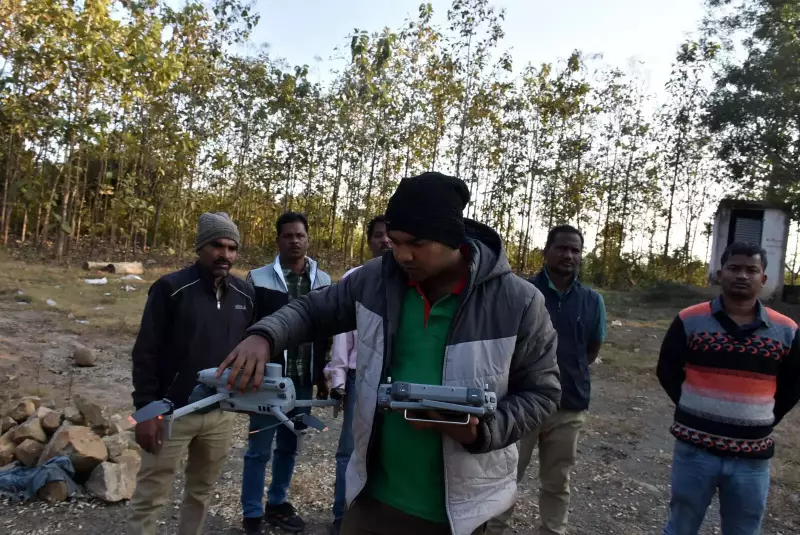
The forest department's operation has intensified, employing night-vision-equipped thermal drones to locate the elusive animal in the thick forests along the border. A senior forester involved stated that teams surveyed about 12 villages in their jurisdiction and are stationed with drones to track movement in the dark. However, drone images show the strongly built elephant hidden in dense foliage, flapping its ears and head, out of reach for tranquilizer darts.
Officials revealed that their Odisha counterparts are attempting to push the killer jumbo back into Jharkhand, fearing similar havoc in their territory. As of now, there is no input suggesting the elephant is straying back into Jharkhand. The crisis is part of a larger pattern, with elephants killing 28 people across Jharkhand in the last 25 days.
In response to the tragedy, about 30 representatives from 20 village panchayats convened a meeting at Kurposi. They unanimously decided to raise funds and arrange food for the affected families, as the government's ex-gratia process is time-consuming. Debraj Patar, a member of Ghorabandha panchayat, emphasized the need for immediate relief for the 19 deceased villagers (excluding the Bengal forester). The villages in Majhgaon, Haldia, and Ghorabandha panchayats, close to the Odisha border, are the most affected.
The situation underscores the fragile human-wildlife conflict in the region, where geography blurs—Kharpos village itself straddles the border, with a football ground half in Odisha and half in Jharkhand. As authorities continue their high-tech hunt, the communities live on edge, waiting for a resolution to the deadly rampage that has shattered their sense of security.






