

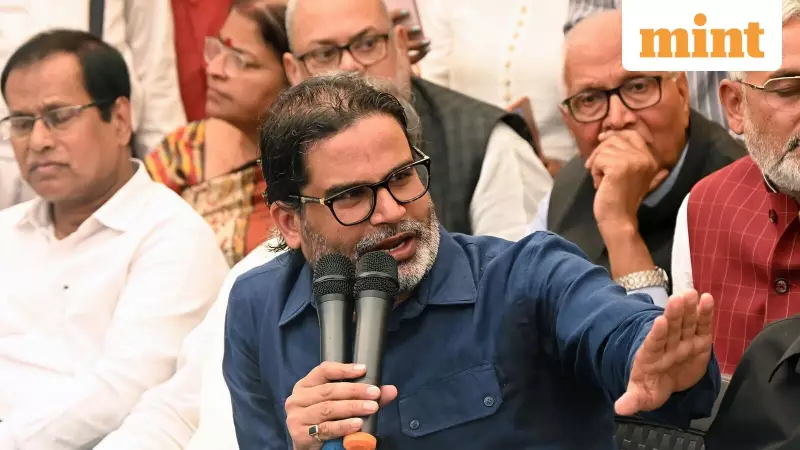
Political strategist-turned-politician Prashant Kishor has broken his silence following the devastating performance of his Jan Suraaj Party in the Bihar assembly elections, drawing surprising parallels with Pakistan's former Prime Minister Imran Khan's early political career.
Humility in Defeat: Kishor's Candid Admission
Addressing reporters in Patna on November 18, 2025, Kishor made a startling confession about his inability to comprehend Bihar's complex political landscape. The founder of Jan Suraaj Party acknowledged his failure to understand the state's electorate while reflecting on his party's complete wipeout in the recently concluded polls.
"I am ready to accept that I couldn't understand Bihar," Kishor stated during his first public reaction to the election results. The former election mastermind, who had orchestrated successful campaigns for several major political parties, found himself on the losing side in his own political debut.

Imran Khan Parallel: Lessons from Political History
Kishor invoked the example of jailed Pakistani politician Imran Khan to contextualize his defeat. He recalled how Khan's Pakistan Tehreek-e-Insaf (PTI) party lost all seven seats it contested in the 1997 general elections, emphasizing that political beginnings are often challenging.
"Imran Khan started his party in Pakistan 25 years ago, contested from seven seats and lost all - so contesting elections is subjective," Kishor explained. The comparison is particularly poignant given that Khan, despite his initial failures, eventually rose to become Pakistan's Prime Minister.
Historical records from the Institute for Defence Studies and Analyses confirm that PTI indeed faced complete rejection in the 1997 polls. It wasn't until the 2002 general elections that Khan managed to secure his first victory from NA-71 Mianwali-I constituency.
The Stark Reality: Election Numbers Tell the Story
The electoral performance of Jan Suraaj Party paints a grim picture of Kishor's political debut. The party contested 238 seats but failed to win even a single one, according to Election Commission of India data.
More embarrassingly, 236 of the party's 238 candidates lost their security deposits, indicating they couldn't secure even 16.67% of valid votes in their respective constituencies. The party managed to secure only 3.5% of the total vote share across Bihar.
Security deposits for assembly elections stand at ₹10,000 for general category candidates and ₹5,000 for SC/ST candidates, refundable only if candidates secure at least one-sixth of total valid votes.
Bihar's Political Reality: Caste and Religion Dynamics
Kishor didn't shy away from criticizing the established political players in Bihar while explaining his defeat. He specifically mentioned his inability to play the caste and religion cards that dominate Bihar's political discourse.
"I also accept that I don't understand how to divide Bihar in the name of caste and religion like Lalu Yadav, Samrat Choudhary, and Ashok Choudhary," Kishor remarked, taking a clear dig at veteran politicians who have mastered these dynamics.
He expressed frustration that his attempts to improve the state were being treated as criminal acts, stating, "Trying to improve the state is not a crime, but people are reacting as if I've committed one - and you all are here for my postmortem."
Context: Imran Khan's Current Situation
The Pakistani leader Kishor referenced is currently serving a 14-year sentence in a corruption case related to the Toshakhana controversy. Although Khan was acquitted in the "cipher case" involving allegations of leaking state secrets, he remains imprisoned due to other ongoing convictions.
Khan's political journey began with his arrest on May 9, 2023, outside the Islamabad High Court, marking a dramatic turn in a career that saw him transition from cricket superstar to political leader.
Kishor's reference to Khan's early struggles suggests he sees his current defeat as potentially temporary, drawing inspiration from leaders who overcame initial political setbacks to eventually achieve success.






