Kolkata Bus Services Experience Revival Following Auto-Rickshaw Fare Revision
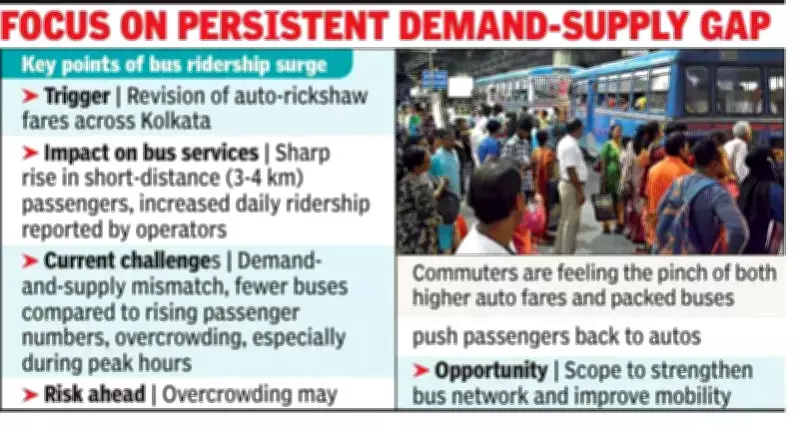
Kolkata's bus services are witnessing a significant revival in ridership, particularly among short-distance commuters, after a recent revision in auto-rickshaw fares across the city. Operators report a noticeable increase in passengers, but this resurgence has highlighted a persistent demand-supply gap, leading to overcrowded buses and raising concerns about the sustainability of these gains.
Shift in Commuter Preferences Due to Cost Factors
Transport operators indicate that the fare hike of Rs 2-5 on auto routes has prompted many passengers, especially those traveling distances of 3-4 kilometers, to return to buses. Buses remain one of the most affordable modes of public transport in Kolkata. However, this surge in demand coincides with a reduced number of buses on the roads, as many have been requisitioned by the Election Commission of India for upcoming polls.
Titu Saha, secretary of the City Suburban Bus Service, stated, "Over the past few days, we've observed a clear jump in passenger count, particularly on short routes. Individuals who previously preferred autos for convenience are now opting for buses because of the cost difference."

Auto Operators Defend Fare Hike Amid Ridership Dip
Auto-rickshaw operators have acknowledged a decline in ridership following the fare revision but defended the increase as necessary. Abdul Rahman, an auto driver operating on the Esplanade-Lohapool stretch, explained, "Fuel prices and maintenance costs have escalated. We had no choice but to revise fares. While some passengers have shifted to buses, many may return if bus services remain overcrowded and unreliable."
Commuters Face Challenges with Overcrowding and Reliability
Commuters are experiencing the dual impact of higher auto fares and packed buses. Sayani Sikdar, a college student, shared, "I used to take an auto for short distances, but now it's too expensive. So I've switched to buses, but they are so crowded that it's difficult to board during peak hours." Another commuter, Sandeep Dhara, an insurance employee, added, "Buses are cheaper, no doubt, but frequency is an issue. When a bus finally arrives, it's already full."
Operators Struggle with Supply-Demand Mismatch
Bus operators admit that the system is struggling to cope with the sudden rise in demand. Tapan Banerjee, secretary of a bus operators' syndicate, noted, "There is definitely a mismatch right now. Passenger numbers have increased, but the number of buses on the road hasn't risen proportionately. This is leading to overcrowding, especially during peak hours." Titu Saha expressed concern, "We are worried that if this trend continues, people might shift back to autos. No one wants to travel hanging from the footboard or squeezed inside a packed bus."
Experts Call for Improved Infrastructure to Sustain Shift
A sustained shift towards buses could potentially reduce traffic congestion and emissions, but only if service frequency and fleet size are increased to meet demand, according to Dipankar Sinha, former KMC director general of Town Planning. Transport researcher Anindyo Guha emphasized, "If authorities can enhance availability and reliability, buses can regain a significant share of urban mobility. Otherwise, this shift may only be temporary."