Kolkata Municipal Corporation Shifts Strategy on Hawker Management
In a significant policy shift, the Kolkata Municipal Corporation (KMC) has declared it will not conduct any eviction drives to remove unauthorized hawkers from city streets. Instead, the civic body will focus on regulating rampant hawking activities through systematic measures. This decision was formally announced by Mayor Firhad Hakim and Member Mayor-in-Council (MMiC) Debasish Kumar during the concluding session of the KMC budget meeting.
New Regulatory Approach Over Eviction Drives
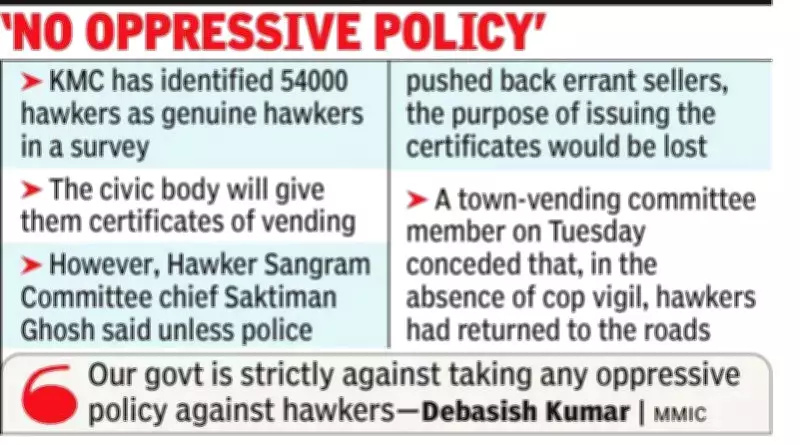
"Our government is strictly against taking any oppressive policy against hawkers and hence we won't conduct any eviction drive," emphasized MMiC Debasish Kumar. "We may need to regulate unauthorized hawking from time to time." This statement marks a departure from previous enforcement approaches and reflects the administration's commitment to balancing urban management with livelihood protection for street vendors.
Kumar elaborated that KMC is actively working to issue certificates of vending to bona fide hawkers as part of this new regulatory framework. "We have identified 54,000 genuine hawkers. This step will pave the way for eliminating unauthorized hawkers," he explained. The certification process aims to create a structured system that distinguishes legitimate vendors from those operating without proper authorization.

Political Opposition and Ground Realities
During the budget debate, BJP councillors Sajal Ghosh and Vijay Ojha strongly criticized the KMC administration for what they described as inaction while pavements continue to be overtaken by new hawkers. Ghosh specifically highlighted the severe hawker encroachment near New Market, noting that "hundreds of traders of the heritage market were suffering a huge business loss" due to the worsening situation.
The concerns extend beyond political rhetoric. New Market traders recently sought intervention from the Chief Minister's Office to address hawker encroachment in and around the grade-1 heritage market. Their request was formally presented at a business conclave organized by the Confederation of West Bengal Trade Associations last December, where Chief Minister Mamata Banerjee served as keynote speaker.
Implementation Challenges and Stakeholder Concerns
Saktiman Ghosh, chief of the Hawker Sangram Committee, expressed skepticism about the certification initiative's effectiveness without proper enforcement. "Unless police pushed back errant sellers, the purpose of issuing the certificates would be lost," he cautioned. This concern was echoed by a town-vending committee member who acknowledged that, in the absence of police vigilance, hawkers had returned to the roads despite previous clearance efforts.
Ashok Gupta, President of the SS Hogg Market Traders' Association, provided specific examples of enforcement gaps. "KMC and police offered hawkers a festive breather before Durga Puja. But despite the pujas being over for a couple of months, the encroachments only grew," he revealed. Gupta pointed out that despite repeated assurances from both KMC and Kolkata Police to keep streets around New Market free of encroachments, the ground situation has continued to deteriorate.
Balancing Urban Governance and Livelihood Protection
The KMC's new approach represents an attempt to navigate the complex challenge of urban street vending in Kolkata. By moving away from eviction drives and toward regulation and certification, the administration seeks to address both the livelihood concerns of thousands of hawkers and the commercial interests of established businesses affected by encroachment.
This policy shift comes amid growing tensions between different stakeholders in Kolkata's urban ecosystem. While the certification of 54,000 genuine hawkers represents a substantial administrative undertaking, its success will depend heavily on consistent enforcement, police cooperation, and ongoing monitoring to prevent unauthorized vendors from undermining the system. The coming months will reveal whether this regulatory approach can effectively balance the competing demands of urban space management and economic inclusion in one of India's most vibrant metropolitan centers.