

Kolkata Police Issue Stern Directive to Auto Unions on Fare Finalization
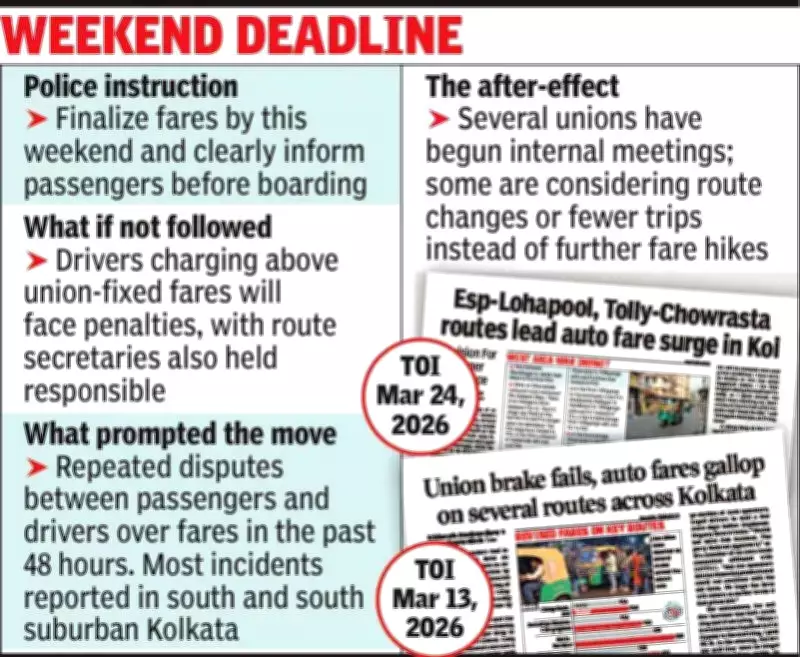
In a significant move to curb escalating conflicts, Kolkata police have formally advised auto-rickshaw unions to decisively establish and publicize their fare structures by the upcoming weekend. Law enforcement authorities have made it unequivocally clear that any driver found charging passengers amounts exceeding the union-mandated rates will be subject to strict penalties. Furthermore, in a notable escalation of accountability, the route secretary of the respective union will also be held personally responsible for such violations.
Rising Tensions Prompt Police Intervention
This police intervention comes as a direct response to a surge in reported arguments and disputes between auto drivers and commuters over the past 48 hours. These incidents have been particularly concentrated in the southern and south suburban regions of Kolkata. A senior officer from a south Kolkata traffic guard emphasized the police's stance, stating, "While we have absolutely no jurisdiction over setting fare prices, we will not tolerate any law-and-order disturbances stemming from inconsistent or unfair fare charging for identical travel distances."
Unions Scramble to Decide on Fare Structure
Following the receipt of this official police "advisory," several prominent auto unions have hastily convened emergency meetings. Unions operating on key routes such as Rashbehari-Behala Chowrasta and Hazra-Ballygunge are actively deliberating their new fare frameworks. However, the decision is fraught with internal conflict. Operators who have already implemented recent fare hikes report facing strong opposition from within their own ranks against instituting another increase. Consequently, unions are exploring alternative strategies, including potential route modifications and reducing the number of daily trips, to maintain financial viability without raising passenger costs.

Arijit Biswas, an operator on the Behala Chowrasta-Rashbehari route, explained the dilemma: "We are hesitant to raise fares again because we risk losing our competitive edge against bus services. The final decision on our course of action is still pending."
Operational Challenges and Fuel Shortages Compound Issues
The fare controversy is unfolding against a backdrop of severe operational difficulties for auto drivers. A widespread practice has emerged where most autos are refusing to operate during non-peak hours. Even during busy office hours, securing an auto has become increasingly challenging. This is due to a new operator policy of only commencing journeys once they can ensure 50%-60% occupancy for their return trip—the leg opposite the typical office-hour traffic flow. This has led to a visible accumulation of idle autos at stands, with routes originating from Chowrasta and Garia reportedly requesting additional parking space from local traffic authorities to accommodate the waiting vehicles.
Swapan Dutta, an operator on a key route, highlighted the economic pressure: "A single trip from Chowrasta to Tollygunge earns us Rs 96. To make the entire round trip financially sustainable, we require at least Rs 60 from the return journey."
Compounding these operational hurdles is a critical shortage of auto fuel, which is reportedly available only at a select few petrol pumps. Drivers, especially those operating from the city's outskirts and connecting to district areas, lament the excessive time and fuel wasted simply in the quest to refuel their vehicles.
Recent Fare Revisions and Passenger Ordeals
Amid this turbulent scenario, a handful of routes proceeded with fare increases on Wednesday and Thursday. Notably, several of these routes had resisted revising their fares since March of this year. Specific revisions include:

- A Rs 2 increase for a trip from Chakraberia to Lake Gardens.
- An additional Rs 2 charged on the Jadavpur-Rabindra Sarobar route.
- Similar hikes implemented between Lake Gardens and Rabindra Sarobar.
- At least two routes in the Dum Dum area increasing fares by Re 1 to Rs 2 per stage.
These disruptions have severely impacted daily commuters. Sutirtha Banerjee, a resident of Silpara, shared a harrowing experience: "I was stranded for over 40 minutes waiting for an auto at Tollygunge Metro station heading to Sakherbazar. Despite there being around 15 autos at the stand around 8:30 pm, the drivers claimed they were out of fuel and could not operate."
The coming weekend is now poised as a critical deadline, with auto unions under immense pressure from both police directives and economic realities to establish a clear, fair, and publicly communicated fare system to restore order to Kolkata's streets.





