

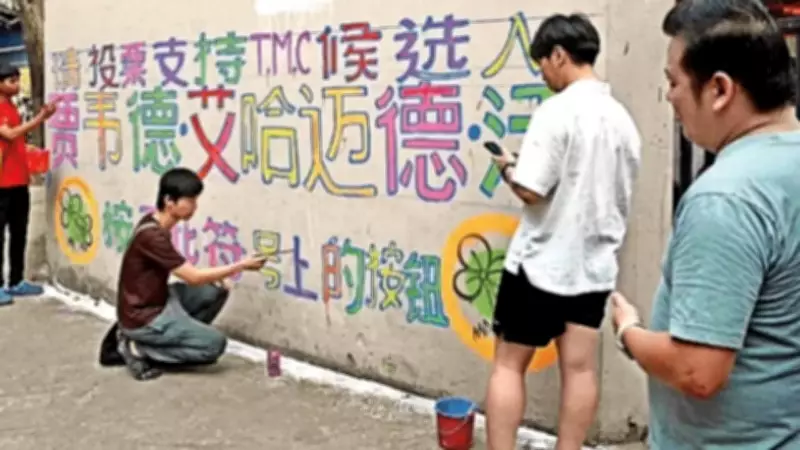
Kolkata's Tangra Chinatown Paints Political Graffiti in Mandarin for Elections
On Thursday afternoon, the Tangra neighborhood in east Kolkata witnessed a distinctive election season ritual. While wall graffiti is a common sight across the city during polls, Tangra offered a unique cultural twist. Men moved through the area with paint buckets and brushes, covering walls with campaign slogans. However, unlike elsewhere in Kolkata where Bengali script dominates, these words stood out—they were written in Mandarin.
A Cultural Identity in Election Campaigning
This unusual campaign scene unfolded in Tangra's historic Chinatown, home to over 1,000 Chinese residents. Members of the community painted political graffiti in support of Trinamool Congress's Kasba candidate, Javed Ahmed Khan, for the April 29 assembly election. In a city where wall graffiti remains a significant feature of electioneering, Tangra's version is shaped by its own cultural identity.
Part of Kolkata Municipal Corporation's ward 66, Tangra is renowned for its Chinese eateries and the community that has lived here for generations. Though far smaller than it once was, Kolkata's Chinese population maintains a visible presence through celebrations like Chinese New Year and its rows of restaurants. This identity finds reflection in the campaign slogans adorning the walls.

Decades of Political Engagement
Steven Lee, a Tangra resident, revealed that he and his friends have been writing wall graffiti in Mandarin for nearly a decade. "We've been doing political graffiti for the past 10 years. Our association with Javed uncle goes back decades—our families knew each other from the days when Tangra still had its tanneries," Lee said. His family was traditionally involved in the tannery business.
The slogans painted across Tangra's walls included familiar campaign phrases such as "Joy Bangla" and "Khela Hobe," but rendered in Mandarin script rather than the Bengali typically seen elsewhere in the city. This linguistic choice adds a layer of cultural significance to the political messaging.
Significance Beyond Electioneering
In Tangra, residents emphasize that the use of Chinese in political messaging carries importance beyond mere campaigning. "The community feels secure and reassured by such gestures. It shows our representatives are not oblivious to us. Messaging in Chinese suggests they want to communicate with us in our own language," said Mark Wong, another resident who participated in the painting.
Most of the Chinese residents still living in Tangra today are fourth or fifth-generation Kolkatans. Their roots in the city run deep, historically through trades such as leather, shoemaking, and food. However, the community has seen a significant decline over the decades.
A Dwindling Community with Deep Roots
The city's Chinese population, estimated at nearly one lakh in the 1960s and 1970s, has dwindled to only a few thousand. The decline began after the 1962 Sino-Indian war, when many families felt alienated and migrated. Another wave of migration in the 1980s took families to countries such as Australia and Canada in search of better opportunities. Later, the closure and relocation of Tangra's tanneries further reduced their numbers.
Candidate's Perspective on Diversity
While campaigning among local residents, Javed Ahmed Khan described Kasba as a constituency shaped by diversity. "My constituency is like a mini India, with people from different parts of the country and different languages and cultures living here. Kasba is also a microcosm of Bengal, where everyone lives peacefully," said Khan, who was present during the graffiti writing. He later campaigned among the Chinese community, reinforcing the inclusive approach.
This election season in Tangra highlights how cultural identities intertwine with political processes, creating a unique narrative in Kolkata's electoral landscape.






