

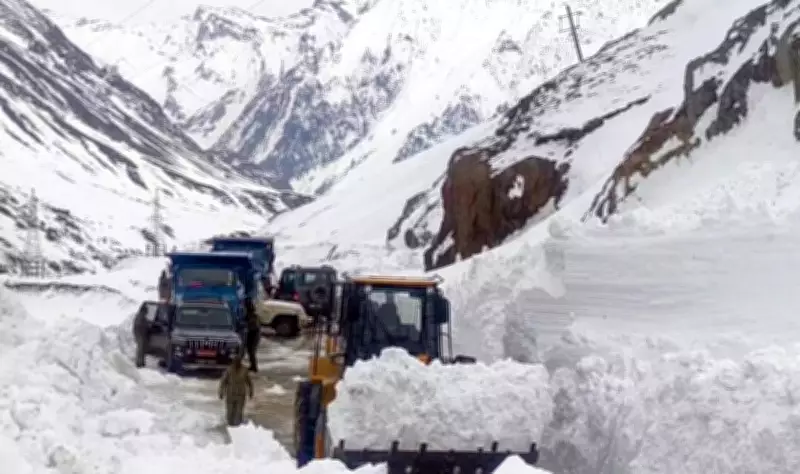
Ladakh Council Accuses Jammu and Kashmir of Lax Response After Deadly Avalanche at Zoji La
In the aftermath of a devastating avalanche that struck Zero Point at Zoji La, resulting in the tragic deaths of seven individuals from Kargil and injuries to six others, the Ladakh Autonomous Hill Development Council-Kargil (LAHDC-Kargil) has leveled serious accusations against the Jammu and Kashmir administration. The council, addressing a press conference in Drass on Saturday, condemned what it described as a lax and delayed response from the J&K authorities, urging both the Union Territories of Ladakh and Jammu and Kashmir to officially recognize Zero Point as part of Ladakh's territory.
Rescue Efforts and Jurisdictional Dispute
During the press conference, LAHDC-Kargil councillors expressed gratitude towards the Indian Army, civil administration, and Ladakh Police for their prompt and efficient rescue operations following the avalanche incident on Friday afternoon. These efforts were crucial in retrieving bodies from the deep snow and providing immediate aid to the injured. However, the councillors voiced significant surprise and concern over the Jammu and Kashmir Police initiating an investigation into the incident on Saturday morning, a move they viewed as an overreach into Ladakh's jurisdiction.
The councillors firmly disputed Jammu and Kashmir's claim that Zero Point, a stretch of approximately five kilometers, falls under its administrative control. They argued that while J&K officials maintain that Zero Point at Zoji La marks the boundary between Ganderbal district in Kashmir and Kargil district in Ladakh, this area is not a formal boundary but rather a location utilized for snow-clearance operations by two wings of the Border Roads Organisation (BRO). Specifically, BEACON handles the Kashmir side, and Vijayak manages the Ladakh side, highlighting the operational division rather than a territorial one.

Historical Context and Demarcation Issues
Dr. Mohd Jaffer Akhoon, the chief executive councillor of LAHDC-Kargil, emphasized that since the abrogation of Article 370 and the bifurcation of Jammu and Kashmir into two separate Union Territories on August 5, 2019, the boundary at Zoji La has remained undemarcated. He asserted that Zero Point should be considered under Ladakh's jurisdiction, pointing to a pattern where the J&K administrative machinery has been slow to respond to mishaps in this area, further fueling the territorial dispute.
Akhoon also raised critical safety concerns regarding traffic management on the Srinagar-Kargil road. He stated that heavy vehicles should not have been permitted to travel alongside light vehicles on the day of the avalanche and recommended that authorities restrict traffic to before 11 am to minimize the risk of vehicles being caught in avalanches. "Local wisdom suggests that during March and April, snow begins to melt at Zoji La in the afternoon, significantly increasing the avalanche risk," he explained, underscoring the need for incorporating traditional knowledge into safety protocols.
Calls for Improved Management and Safety Measures
While praising the BRO for its commendable work in keeping Zoji La accessible during the harsh winter months, Akhoon stressed that better management and greater consideration of local wisdom are essential to prevent such tragic accidents in the future. The council's allegations highlight ongoing tensions between the two Union Territories over territorial control and administrative responsiveness, particularly in remote and hazardous regions like Zoji La, which sits at an altitude of over 11,500 feet.
This incident has not only brought to light the immediate dangers posed by avalanches in high-altitude areas but also reignited debates over jurisdiction and governance in the wake of Jammu and Kashmir's reorganization. The LAHDC-Kargil's call for clear demarcation and improved safety measures underscores the urgent need for coordinated efforts between Ladakh and Jammu and Kashmir to ensure the protection of lives in this vulnerable region.






