

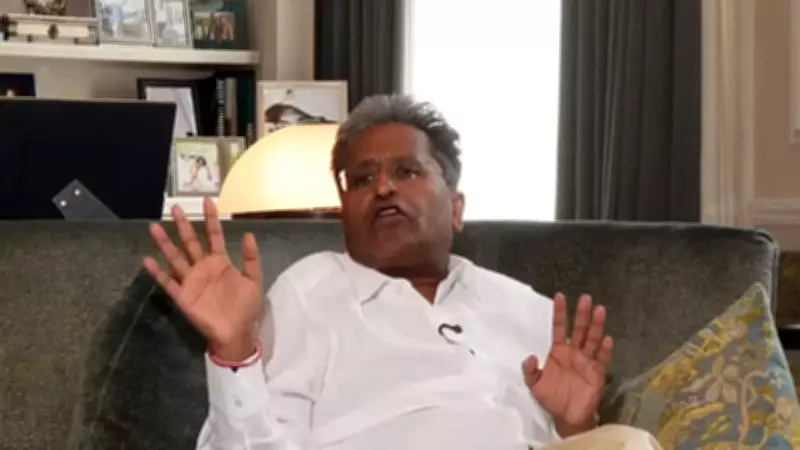
Former Indian Premier League (IPL) commissioner Lalit Modi has declared India the undisputed powerhouse of world cricket, asserting that the sport's global economy revolves around the Indian market. Modi, who has been residing primarily in London since leaving India in May 2010, shared his views during an appearance on Wisden Cricket's podcast The Scoop. He discussed Indian cricket's influence on the global game, the Future Tours Programme (FTP), the International Cricket Council's (ICC) business model, and comparisons with football.
India's Central Role in International Cricket
According to Modi, India's importance to the sport is such that international cricket cannot thrive without the country's involvement. He stated unequivocally, "There is no FTP without India. Simple as that. There is no cricket without India anywhere in the world. There may be some money in England versus Australia. That is it. Everybody else depends on India."
Modi elaborated on the scheduling dynamics, noting that England protects its traditional summer window from May to September, which is the best time for cricket in England. He argued that India should similarly secure its optimal playing months: October, November, December, January, and February. "So what is the best time to play cricket in India? Simple as that. The best time to play cricket in India is October, November, December, January and February," he said.

Commercial Value and Player Exhaustion
The former IPL chief emphasized that every cricketing nation wants to play India because of the commercial value attached to such contests. He added that India does not need to field its strongest side for every series and warned against overburdening players. "Everybody wants to play India. That's where the money is. Okay, that's where it is. We don't have to have an A team playing there every time. You can't have an A team playing every game. You will exhaust our players. You only have 105 days. How many countries do you have? Does Messi play every game for Argentina? No. So if you're trying to tell me that India can have Team A, Team B, Team C, Team D, let them play the other games. But you won't get the traction," Modi explained.
Shift Towards Club Cricket
Modi further claimed that the future of cricket lies increasingly in club-based competitions rather than traditional international structures. He asserted, "I'll tell you now, the traction is only going to be at club cricket, whether India plays or doesn't play. So ICC's job is to increase it. But they are in the wrong business, I'll tell you now, because the business model has changed. It has gone into club cricket."
He described the ICC as a collection of countries that sells media rights collectively and manages the game transparently, but argued that the business model has shifted. "What is ICC? ICC is a collection of countries put together to enhance media rights by selling the rights together. That's all it is. And manage the game in a transparent manner globally. And they've done a great job doing that. But the business model has changed," Modi said.
Learning from Football's Model
Drawing comparisons with FIFA, the governing body of football, Modi suggested that cricket should follow a similar model and reduce the frequency of global tournaments. He noted that FIFA generates its revenue primarily from the World Cup held once every four years. "Similarly, FIFA is in the business of global football now. Where does FIFA's money come from? Once in four years. Do your once-in-four-years event and build it up. Don't try to do a T20 World Cup, ODI World Cup and Test World Cup. You've got three formats and now you want to do it every year. That's where the window problem is, right there," he argued.
Modi proposed a four-year cycle for major ICC events, similar to football's international calendar. "If the ICC concentrated on a four-year cycle, concentrated then on the Olympics, you do the Olympics every four years, then after two years you start the second cycle of the T20 World Cup. You will be able to sustain it. FIFA is every alternate year if you look at it. So you do the same window concept, but not on a yearly basis. The FTP today is on a yearly basis. Follow the football example. Don't follow anything else. Follow the football example," Modi said.

Cricket's Potential to Rival Football
He concluded by arguing that cricket has reached a stage where it can learn from football's decades of commercial and organisational development. "Cricket is becoming as big as football. If cricket is becoming as big as football, or bigger than football, then why should we be different from football? They have already done 50 years of learning. You don't have to reinvent the wheel," Modi said.





