

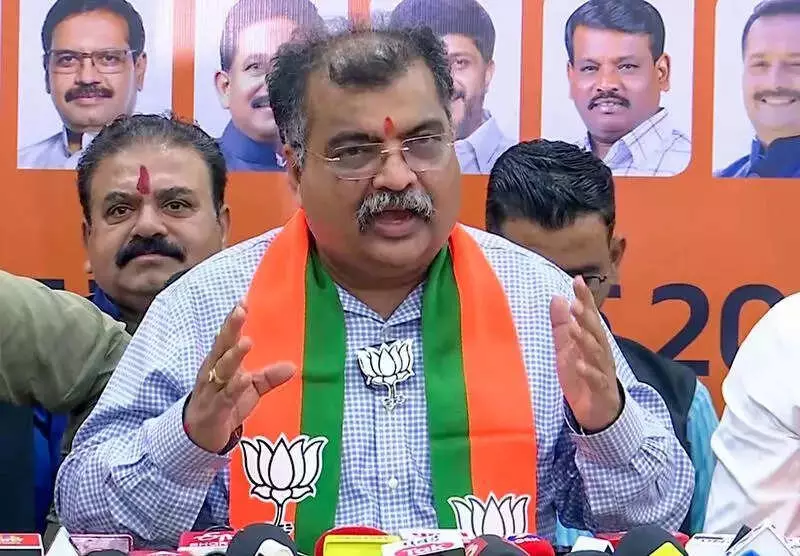
Maharashtra's political landscape has been ignited by a fresh controversy, with the state's Bharatiya Janata Party (BJP) chief pointing a finger at the Nationalist Congress Party (NCP). In a statement that has stirred the pot, BJP President Chandrashekhar Bawankule asserted that the NCP was the original architect of the 'Operation Lotus' strategy in Maharashtra, long before the term became synonymous with political maneuvering.
The Core Accusation: Who Started the Defection Game?
Chandrashekhar Bawankule's comments came as a direct rebuttal to allegations frequently leveled against the BJP by opposition parties. The term 'Operation Lotus' is often used by critics to describe alleged attempts by the BJP to engineer defections and topple elected governments. However, Bawankule turned the tables by claiming the practice has older roots in the state.
He specifically referenced the political crisis of 2010 during the Congress-NCP coalition government. Bawankule alleged that it was the NCP, under Sharad Pawar's leadership, that first attempted to split the Shiv Sena. This historical reference is at the heart of his argument that the NCP, not the BJP, set the precedent for such political operations in Maharashtra.

"They (NCP) started it first in Maharashtra," Bawankule stated, firmly placing the onus on the rival party. His remarks are seen as a strategic counter-narrative to insulate the BJP from continuous accusations of destabilizing governments through defections.
Context and Political Repercussions
This war of words does not exist in a vacuum. It erupts against the backdrop of intense political rivalry in Maharashtra, a state that has witnessed significant realignments in recent years. The most notable being the split within the NCP itself in 2023, when a faction led by Ajit Pawar joined the ruling government alongside the BJP and Shiv Sena (Eknath Shinde faction).
The BJP state chief's statement is a clear political maneuver. By accusing the NCP of pioneering defection politics, Bawankule aims to:
- Neutralize the opposition's 'Operation Lotus' narrative against the BJP.
- Justify recent political changes by framing them as part of a pre-existing political culture.
- Put the Sharad Pawar-led NCP faction on the defensive by reminding voters of past political strategies.
This accusation is likely to escalate the ongoing verbal duel between the BJP and the factions of the NCP, especially as political positioning for future elections intensifies.
A History of Defections: The 2010 Flashpoint
Bawankule's claim hinges on the events of over a decade ago. In 2010, the Congress-NCP coalition government was in power. Political circles were rife with speculation about the NCP's internal dynamics and its relationship with allies and opponents alike. The BJP chief's reference suggests a belief that the NCP explored the possibility of dividing other parties to consolidate its own power, a tactic he equates with what is now called 'Operation Lotus'.
This historical counter-accusation is a common tool in political rhetoric, used to deflect criticism by arguing that the accuser is guilty of the same actions. It reframes the current political discourse from "who is doing it now" to "who did it first."
The immediate consequence of this statement is a further hardening of positions. The NCP is expected to issue strong denials and counter-accusations, keeping the issue of political defections and ethical governance at the center of public debate in Maharashtra. For the average voter, this exchange reinforces the perception of a political arena where shifting loyalties and strategic defections have become a normalized, if controversial, aspect of the game.
Ultimately, Chandrashekhar Bawankule's direct accusation against the NCP is more than a mere tit-for-tat. It is a calculated effort to rewrite the narrative of political instability in Maharashtra. By claiming the NCP authored the playbook for defections, the BJP seeks to morally equate current events with past actions, complicating the opposition's critique and appealing to a sense of historical continuity in the state's often turbulent politics.






