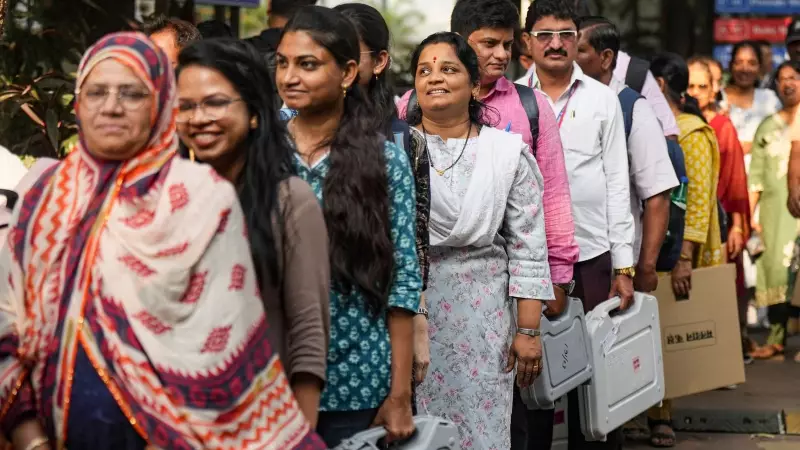
Voters across Maharashtra are heading to the polls today to elect representatives for 29 municipal corporations. This includes the crucial Brihanmumbai Municipal Corporation (BMC) in Mumbai. The ruling Mahayuti alliance aims to secure a dominant position despite visible internal disagreements among its three partner parties.
High-Stakes Urban Battle
The opposition Maha Vikas Aghadi (MVA) is fighting hard to keep its political challenge alive. A vigorous campaign period saw old alliances breaking apart and new partnerships forming across the state's urban landscape. Elections were originally scheduled for 2,869 seats, including 227 in the BMC. However, polling will now occur for only 2,801 seats because 68 candidates won their positions unopposed.
Controversies Mark Campaign Season
The election season began with controversy over those unopposed victories. Opposition parties alleged the use of money and muscle power to secure these wins. The State Election Commission (SEC) has stated it requested reports from municipal commissioners regarding these uncontested elections.

Campaigning officially ended on January 13, but the SEC permitted continued door-to-door outreach activities. The commission clarified this rule has been in place since 2012. On the final day before voting, widespread allegations emerged about ruling party members distributing money in several areas.
Unusual Political Realignments
These municipal elections have created unprecedented political scenarios across Maharashtra. Traditional battle lines have completely dissolved into confusion. Both the ruling Mahayuti and opposition MVA alliances have failed to maintain consistent political equations across different regions.
Neighboring cities are witnessing completely different political dynamics. An alliance partner in one urban area becomes the main opponent in the next. For instance, the BJP and Eknath Shinde-led Shiv Sena are allies in Mumbai, Thane, and Kalyan-Dombivli. Yet they are competing directly against each other in Mira-Bhayander and Navi Mumbai.
Cross-City Alliance Variations
Similarly, the BJP and Ajit Pawar-led NCP are opponents in Pune and Pimpri-Chinchwad but allies in Ahilyanagar and Kolhapur. Campaign violence between Shinde's Shiv Sena and BJP marked electioneering in Thane, Navi Mumbai, and Kalyan-Dombivli. In Pune, Deputy Chief Minister Ajit Pawar aggressively targeted the BJP during campaigning.
This prompted state BJP chief Ravindra Chavan to express regret about allying with Pawar in the state government. Opposition parties are also displaying contradictory positions across different cities. A party might oppose a ruling alliance member in one municipality while seeking votes alongside that same ruling party in another location.
New Political Partnerships Emerge
The NCP and Sharad Pawar-led NCP (SP) joining forces in Pune and Pimpri-Chinchwad has revived speculation about a possible merger between the two factions. Leaders from both parties have remained silent on this possibility, but sources indicate preliminary discussions may have begun.
The Congress party has formed an alliance with Prakash Ambedkar's Vanchit Bahujan Aghadi (VBA) in Latur, Nanded, and Mumbai. Meanwhile, Congress has withdrawn from the MVA alliance in several key cities including Mumbai, Thane, Nagpur, and Chandrapur.
Top Leaders Campaign Vigorously
Senior politicians from all major parties participated actively in campaign rallies. Chief Minister Devendra Fadnavis led the BJP's statewide campaign efforts. Eknath Shinde visited more than 51 locations to support his party's candidates.
Ajit Pawar concentrated his campaigning power to defend his stronghold areas of Pune and Pimpri-Chinchwad. From the opposition side, Maharashtra Congress chief Harshvardhan Sapkal held rallies in all municipal corporations holding elections. Prakash Ambedkar and his son Sujat focused their efforts on Akola, Amaravati, Solapur, and Mumbai.
Voting System Variations
Except for Mumbai, elections in the other 28 municipal corporations are being conducted under a multi-member ward system. In Mumbai, each voter casts only one ballot since each ward elects a single representative. In the remaining 28 corporations, most wards will elect four representatives, though some may have three or five seats.

Precautions Against Duplicate Voting
The State Election Commission is using Assembly constituency voter lists prepared by the Election Commission of India for these local body elections. The SEC established July 1, 2025 as the notified date and divided existing Assembly lists into ward-specific voter rolls.
A double asterisk (**) mark appears next to names of potential duplicate voters in these ward lists. These voters received requests to specify which polling station they intended to use. Election officials conducted door-to-door verification and collected applications in a prescribed format.
Such voters will only be permitted to cast ballots at their designated polling stations. If election workers could not collect an application for any reason, the voter must provide a written undertaking at the polling station. They must declare they have not voted elsewhere during these elections. These voters will undergo strict identity verification before receiving permission to vote.