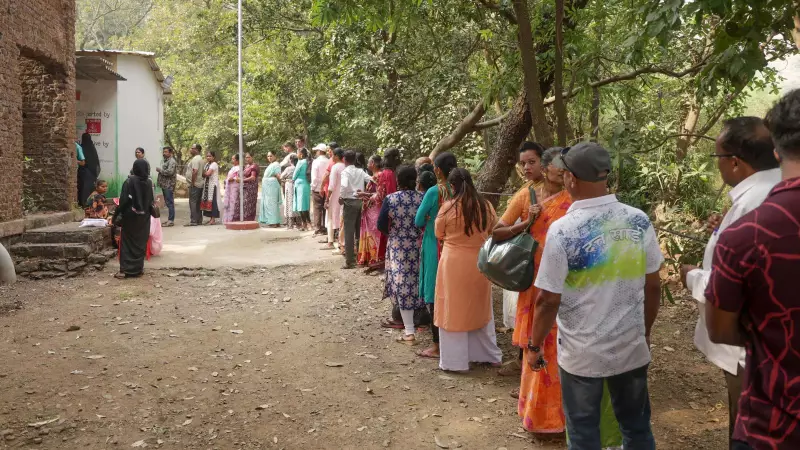
Maharashtra is witnessing a spectacle of unprecedented political chaos and opportunism as it heads towards crucial elections for 29 municipal corporations on January 15, 2026. Dubbed as "mini assembly elections," the urban body polls have laid bare the ugly and unscrupulous underbelly of the state's politics, where ideological consistency and basic civility have been discarded in a desperate quest for power.
Alliances of Convenience: A Tangled Web
The political landscape ahead of the polls is a bewildering maze of contradictory partnerships. The ruling three-party Mahayuti alliance at the state level—comprising the BJP, the Eknath Shinde-led Shiv Sena, and Ajit Pawar's NCP—has completely unraveled at the local level. Constituents are freely partnering with opponents, making it exceptionally difficult to track who is aligned with whom.
In a stark example, Ajit Pawar's NCP is challenging the BJP's hegemony in Pune, despite being part of the same ruling coalition in Mumbai. This is the same BJP that helped Ajit Pawar step out of his uncle and NCP founder Sharad Pawar's shadow. Yet, Ajit has now sought the senior Pawar's help to fight the BJP, which has publicly expressed regret over its alliance with "Ajit dada."
Similarly, the Shinde-led Shiv Sena is allied with the BJP in Mumbai but is fighting against it in several other municipal bodies. This has created a situation where the equation A+B=C in one city yields a completely different result in a neighbouring city, rendering traditional political arithmetic meaningless.
Rampant Defections and Cadre Anger
This environment has triggered an epidemic of political infidelity. Party-hopping became so rampant that instances were recorded of candidates changing allegiances three times in a single day. A notable case from Nashik saw two local satraps, initially loyal to the Uddhav Thackeray-led Shiv Sena, publicly vow to "drown the BJP in the Ganga" only to be found in the BJP camp the very next day, promising to finish off the Sena.
No party has shown the courage to reject this promiscuity. The BJP, once branding itself as the "party with a difference," has been exceptionally welcoming, prioritizing the winnability of candidates over loyalty. In 19 out of the 29 corporations, the BJP has fielded 337 candidates imported from rival parties. This wholesale embrace of defectors has sparked unprecedented anger within the BJP's own ranks, leading to attacks on party offices, ministers' vehicles being blackened, and party officials fleeing from angry ticket aspirants.
The Missing Civic Agenda and Legitimising Lumpen Elements
Perhaps the most alarming aspect of this high-voltage political drama is the complete absence of civic issues from the campaign discourse. In one of India's most urbanised states, grappling with haphazard development and decaying infrastructure like in Mumbai, no party or leader is seriously raising local problems affecting urban life.
Instead, in a naked pursuit of electoral victory, parties are openly welcoming lumpen and undesirable elements with questionable reputations and no political ideology. The tradition of nurturing constituencies is being set aside for local strongmen who promise captive vote banks. These satraps receive political patronage, and in return, the establishment legitimises their activities, often centred on converting open spaces for "development" that strengthens the builder-politician nexus.
This trend renders the entire model of urban governance obsolete. The elections, following polls for smaller municipal councils two weeks prior and to be followed by zila parishad elections, demonstrate a spectacularly flawed system where politics has created not just strange bedfellows, but a perverse and cynical game with no red lines left to cross.