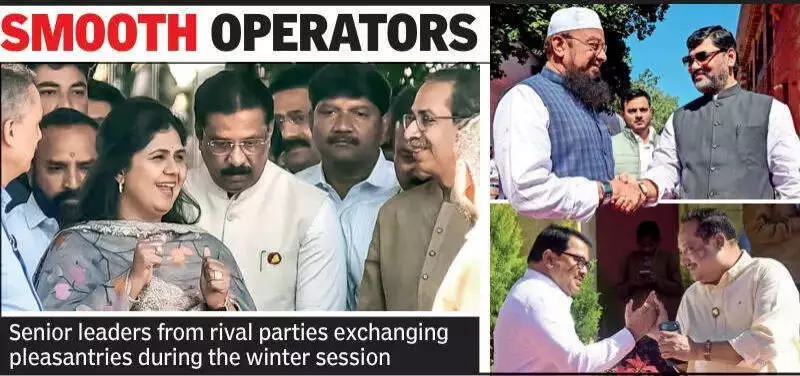
The winter session of the Maharashtra legislature, held in Nagpur, has drawn to a close, leaving political observers surprised by an atmosphere of uncommon tranquility. The week-long proceedings, often a hotbed for fiery debates and protests, functioned with a mechanical efficiency that underscored a curious disengagement from the usual political theatrics.
A Session Defined by Productivity, Not Protest
Contrary to all expectations, the session unfolded with barely a ripple of disruption. Legislative business moved at a brisk pace. The State Assembly passed a total of 16 Bills and cleared six ordinances. Furthermore, supplementary financial demands worth over ₹75,000 crore were approved with minimal resistance from the opposition benches. Around 70 calling attention motions were discussed, and the Legislative Council passed four Bills.
By any parliamentary benchmark, the session was notably productive. However, measured against Nagpur's own political history—a place shaped by stormy debates and vociferous protests—the calm was strikingly out of character. Over seven days, the Assembly sat for more than 72 hours, averaging over 10 hours of work daily. There was only one brief disruption, lasting about 10 minutes, and a single symbolic protest by opposition members on farmers' issues held on the Assembly steps.

Muted Opposition and Missed Opportunities
This lack of confrontation highlighted significant organizational challenges within the opposition Maha Vikas Aghadi (MVA) alliance. The session ended without recognised opposition leaders in either House, pointing to internal weakness. This fragility was laid bare during a discussion when senior Congress leader Nana Patole staged a walkout after an opposition resolution was not taken up for debate. His intended gesture of collective protest turned into a solitary act as no other opposition member followed him, severely undercutting the political message.
Traditional street mobilisations, an inseparable part of Nagpur's winter sessions, were similarly muted. The few morchas that did take place were small and failed to influence the broader political discourse. Farmer groups, who had hoped Nagpur would become a pressure point for their demands, found their protests limited in both scale and impact.
Government's Smooth Sailing and a Quiet Exit
For the ruling government, the prevailing calm translated into an unchallenged passage of crucial legislation and spending approvals. The session wrapped up by 3 pm on the final day, earlier than usual, and notably, the ruling alliance skipped its customary end-of-session media interaction, adding to the sense of an uneventful conclusion.
The overall assessment is clear: the government managed its legislative agenda efficiently in a vacuum of effective opposition. For the MVA, the session exposed deep fragmentation, limited coordination, and an apparent inability to convert public discontent, especially on agrarian issues, into tangible parliamentary pressure. The quiet halls in Nagpur spoke volumes about the current state of Maharashtra's political dynamics.