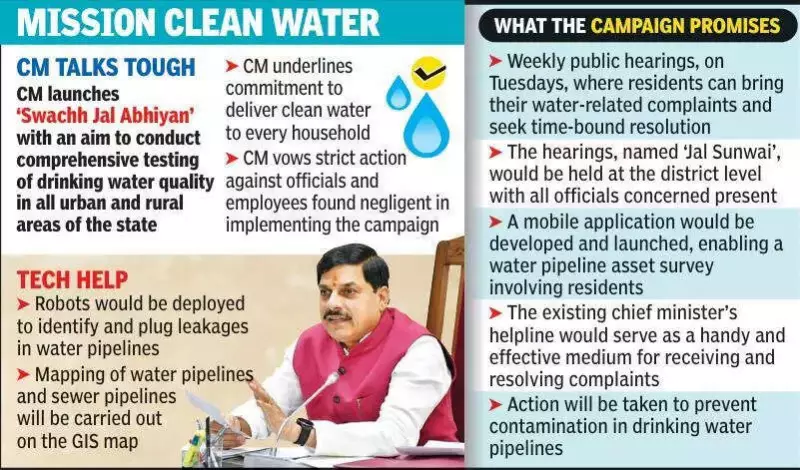
In a decisive move following the tragic deaths linked to water contamination in Indore, Madhya Pradesh Chief Minister Mohan Yadav launched the ambitious 'Swachh Jal Abhiyan' on Saturday. The campaign aims to conduct comprehensive testing of drinking water quality across all urban and rural areas of the state.
A Direct Response to Tragedy
The launch gains critical urgency as it comes immediately after six diarrhoea deaths in Indore's Bhagirathpura area, which were linked to a dangerous mix-up of sewage with a groundwater source. Addressing the issue head-on, CM Yadav, speaking at a virtual event attended by mayors, municipal chiefs, and state officers, stated that delivering clean water to every household is a 'salient responsibility' of the government.
He emphasized a zero-tolerance policy towards negligence, warning that strict action would be taken against officers and employees failing in their duties. "Under no circumstances should contaminated drinking water be supplied to households," the Chief Minister asserted.

Key Features of the Swachh Jal Abhiyan
The campaign introduces several innovative public-centric mechanisms. The cornerstone is the 'Jal Sunwai' – a weekly public hearing to be convened every Tuesday at the district level. Here, citizens can bring water-related complaints for priority redressal.
The government outlined a multi-pronged approach for the campaign:
- Technology-Driven Monitoring: A mobile app will be developed for water pipeline asset surveys involving residents. A GIS map-based application will monitor the cleaning of all water purification systems and storage tanks.
- Advanced Leak Detection: Mapping of water and sewer pipelines on GIS to identify intersection points. The government plans to deploy robots and use state-of-the-art technology to identify and plug leakages.
- Accessible Testing: Consumers will have access to water quality testing services at nominal charges, alongside periodic official sampling.
- Enhanced Grievance Redressal: The existing CM helpline (181) will be leveraged for water complaints, with a promise of time-bound resolution. Ward and panchayat committees will be strengthened for local complaint resolution.
Phased Implementation and Broader Goals
Officials stated the campaign will be rolled out in two phases: Phase I from January 10 to February 28, and Phase II from March 1 to May 31. The broader objectives are threefold: ensuring water security, promoting water conservation, and institutionalizing weekly public hearings on water issues.
The initiative will be linked with the Swachh Bharat Mission and receive support from the Health and Women and Child Development departments. Continuous public awareness activities will be carried out to foster community participation.
The ultimate goal, as stated by the government, is to set a national example in overcoming the major challenge of providing safe, clean drinking water to every citizen through effective governance and technological intervention.