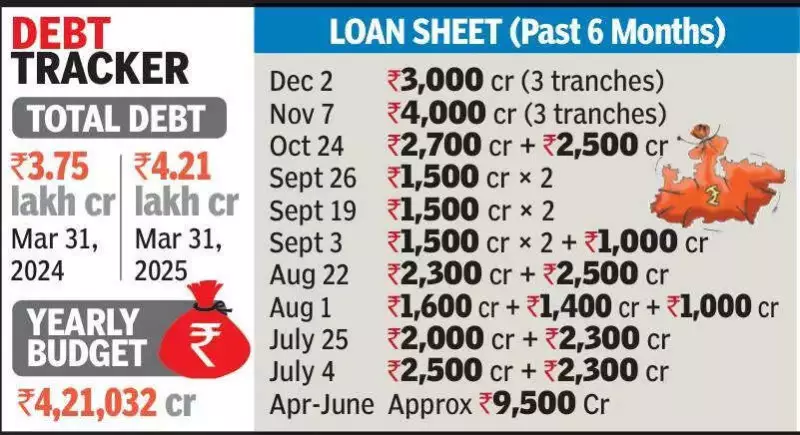
The Madhya Pradesh government has been borrowing an average of more than Rs 125 crore every single day over the past two years, a revelation that brings the state's escalating debt into sharp focus. The issue gained prominence as the Mohan Yadav-led government completed two years in office on December 13.
Debt Outpaces State Budget
The cumulative debt of the state has now surged past the staggering figure of Rs 4.65 lakh crore. To put this in perspective, this debt is significantly higher than the state's entire annual budget. For the upcoming financial year 2025-26, the state legislature passed a budget of Rs 4.21 lakh crore, which is notably less than the outstanding liabilities exceeding Rs 4.65 lakh crore.
During a one-day special session of the Madhya Pradesh Legislative Assembly on December 17, organized to mark 70 years of its first session, Chief Minister Mohan Yadav addressed the concerns. He stated that the state's economy has been growing at an impressive rate of approximately 14-15 percent over the last two years since his government took charge.

Government's Justification for Borrowing
On the contentious issue of debt crossing the budget, CM Yadav pointed out that a major portion of the total loan burden was inherited from previous administrations. This stance has been consistently echoed by Deputy Chief Minister and Finance Minister Jagdish Devda, who maintains that loans are essential for infrastructure development.
The government's official position, as stated in its gazette notifications before securing loans, is that all borrowed funds are primarily used for the state's development and creating income-generating assets. The listed utilizations include:
- Construction of irrigation projects like dams, canals, tanks, and wells.
- Improvement of communications and transport services.
- Investment in the share capital of Co-operative Banks and Societies.
- Providing loans to cultivators and local bodies, who repay with interest.
- Funding for power generation, transmission, and distribution companies under the state's Energy Department.
The gazette further asserts that while no formal valuation of the state's physical assets has been conducted, their value is assumed to far exceed the outstanding liabilities.
The Ladli Behna Scheme: A Major Financial Commitment
A significant and growing financial commitment for the state is the flagship Ladli Behna scheme. The monthly financial burden for the program has increased by over Rs 300 crore following the government's decision to raise the monthly payout from Rs 1,250 to Rs 1,500 per beneficiary.
Consequently, the monthly allocation required has jumped from over Rs 1,540 crore to approximately Rs 1,850 crore. The government has pledged to incrementally increase this payout to Rs 3,000 per month by 2028. Chief Minister Yadav has even expressed a desire to eventually provide Rs 5,000 monthly to the 'Ladli Behnas' (women beneficiaries), though no timeline for this enhancement has been announced.
Officials also highlight that the state needs funds to contribute its share for various centrally sponsored schemes. They clarify that the consent of the central government is obtained for every loan the state undertakes, ensuring the borrowing is within the framework of fiscal federalism.