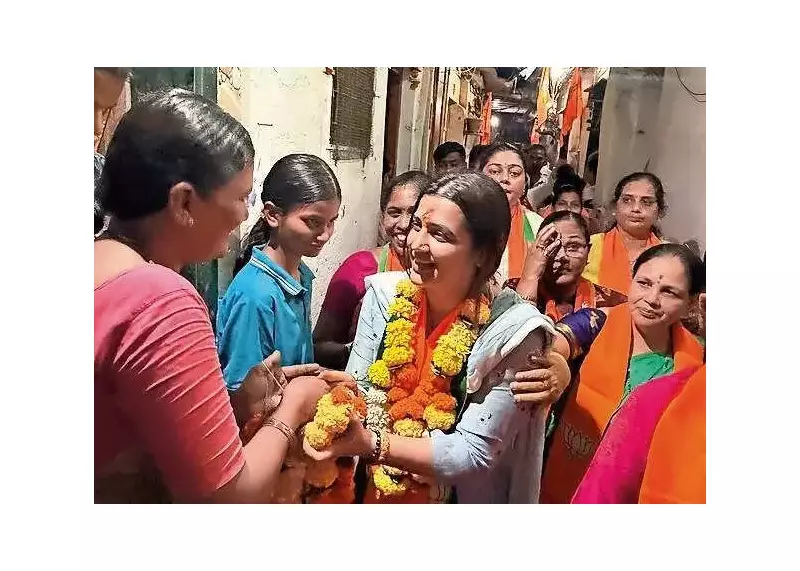
In the narrow bylanes of Bhablipada chawl in Mumbai's Dahisar East, a significant political shift unfolded on a recent Tuesday evening. Former corporator Tejasvee Ghosalkar, now a Bharatiya Janata Party (BJP) candidate, led a campaign trail of women supporters, marking her first electoral foray after switching from Shiv Sena (UBT).
Campaign Promises and a Key Ward Issue
The campaign in Ward 2, which includes parts of Borivli and Dahisar, centered on a long-standing local grievance: stalled redevelopment projects. For years, residents of Bhablipada have watched builders come and go, with progress halted by building height restrictions. These restrictions were imposed due to high-frequency radar installations operated by the Airport Authority of India.
"Many builders came and left... we are waiting," shared an elderly resident, capturing the community's frustration. Ghosalkar, 38, seized on this issue, promising a permanent resolution. Her pledge gained credibility following last month's state government decision to relocate the radar stations, a move expected to unlock acres of land for affordable housing and redevelopment.

"People know the work I did as a corporator in Ward Number 1 in the past," Ghosalkar stated, invoking her late husband and former corporator Abhishek Ghosalkar. She emphasized her previous connection with the Catholic community and vowed to build similar ties with the Maharashtrian and Gujarati communities in her new constituency.
A Direct Challenge from Shiv Sena (UBT)
Less than a kilometre away, the political landscape was being contested on a different front. Shiv Sena (UBT)'s candidate for Ward 2, Dhanashree Kolge, was conducting a door-to-door campaign in Anand Nagar and Sambhaji Nagar. A 34-year-old Yuva Sena member and local resident, Kolge is contesting her first election.
Armed with a degree in home science and nutrition and 12 years of ground experience with Yuva Sena, Kolge presented herself as the candidate who truly understands local civic issues. At the Jay Gokul society, residents pointed out problems like choked gutters, poor roads, and water-logging.
Kolge proposed replicating solutions conceptualized by UBT leader Aditya Thackeray, such as underground water holding tanks used in Hindmata, for Dahisar's low-lying areas. Her campaign, energized by a young brigade of Yuva Sena members, friends, and family, expressed confidence in securing a good lead for the party.
A Multi-Cornered Contest
The electoral battle in Ward 2 is not a simple two-party fight. Besides the prominent campaigns of BJP's Tejasvee Ghosalkar and Shiv Sena (UBT)'s Dhanashree Kolge, the Congress party's Menaka Singh and Independent candidate Sunita Bhatia are also in the fray. This sets the stage for a closely watched and potentially tight municipal election result.
As Ghosalkar received warm hugs from elderly supporters and Kolge detailed her plans for civic infrastructure, the contrasting campaigns highlighted the core issues at stake: resolving a major, stalled redevelopment project versus addressing day-to-day civic grievances. The outcome in Ward 2 will be a key indicator of Mumbai's shifting political loyalties and local priorities.