The electoral battle for control of the Nagpur Municipal Corporation (NMC) has reached a feverish climax, with campaigning set to conclude at 5:30 PM on January 13. This leaves political parties and candidates in a desperate race against time before the city's voters head to the polls on January 15.
A High-Stakes Contest with Record Participation
A total of 993 candidates are competing for 151 seats in the civic house. Reflecting the mandate for women's representation, 76 seats are reserved for women. Furthermore, in a sign of changing dynamics, 14 women candidates are contesting from the open category, directly challenging male rivals in 11 wards and intensifying the competition across Nagpur.
This election cycle is notable for its unusually compressed timeline. For what is believed to be the first time in NMC's poll history, the campaign period has been drastically shortened, transforming it into a high-pressure sprint. Candidates have had mere days, instead of the typical weeks, to establish their presence, mobilize party workers, secure necessary permissions, and physically reach out to constituents.

Campaign Strategies: Rallies, Rallies, and Grassroots Push
The campaign intensity is palpable across Nagpur's wards. While the single-window system granted permissions for 20 new public meetings, most political outfits have prioritized hyper-local, street-level engagement over large-scale rallies.
The Bharatiya Janata Party (BJP) launched the most aggressive campaign blitz. This followed three rallies addressed by Maharashtra Chief Minister Devendra Fadnavis on January 6. The party maintained momentum with a packed schedule of meetings by Union Minister Nitin Gadkari and BJP state president Ravindra Chavan through January 12.
In contrast, the Congress party organized just one major rally, led by its state chief Harshwardhan Sapkal, choosing instead to concentrate its efforts on a widespread house-to-house contact program. Other significant state parties, including the BSP—which had 10 corporators in the previous house—along with both factions of the NCP and the two Shiv Sena camps, largely avoided large rallies, opting for quieter, localized outreach.
The Doorstep Battle and Visual Onslaught
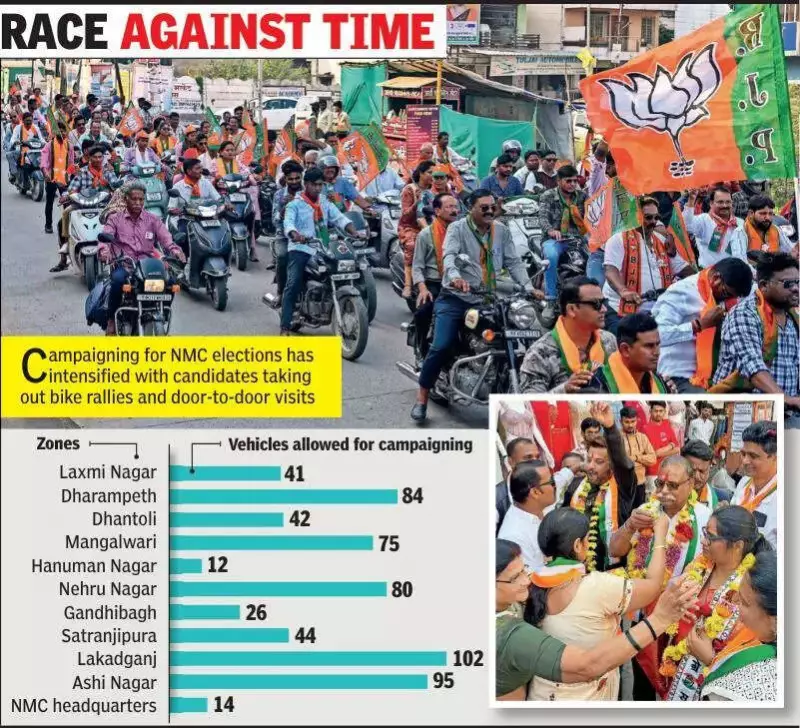
On the ground, door-to-door campaigning emerged as the undisputed mainstay of electioneering. BJP cadres in several wards ramped up early morning visits and organized neighbourhood meetings. The Congress also diligently knocked on doors, highlighting issues of civic services and transparency in governance.
For independent candidates and newcomers, the short timeline presented a herculean challenge. With limited resources and no established party machinery, their primary fear was being drowned out before they could even make an impression. Smaller parties and independents alike conducted their own door-to-door visits, scrambling to recruit volunteers, print campaign material, and manage social media outreach—all within a few days.
The visual landscape of the city has been transformed into an electoral battlefield. Officially, 102 BJP posters were erected through proper channels. However, a parallel flood of illegal banners and hoardings mushroomed across traffic islands, electricity poles, and garden walls. This has left the NMC's zonal offices struggling to enforce rules, even inviting a contempt petition against the civic body for its inaction.
Adding to the buzz on the streets, the Regional Transport Office (RTO) granted permission for over 600 vehicles to be used for electioneering, according to RTO Kiran Bidkar. With time at a premium, candidates, especially independents, have been spending significant sums to deploy these campaigning vehicles to broadcast their messages.
Seasoned political observers note privately that abbreviated campaigns inherently favour well-organized parties with ready-made networks, resources, and brand recognition. First-time contenders are at a distinct disadvantage, forced to build everything from scratch in a matter of days.

Yet, amidst this frenetic rush, one unifying strategy cuts across all party lines: the imperative to meet voters repeatedly before the clock runs out. As the contest for Nagpur's civic house tightens, the campaign has truly become a race against the calendar, where every lane walked and every door knocked upon could tip the scales.