Nagpur Mayor Election Sparks Intense BJP Internal Competition
The political landscape in Nagpur has been set ablaze with anticipation as the Nagpur Municipal Corporation prepares to elect its 55th mayor. In a surprising turn of events, the mayor's post has been reserved for a woman from the open category, triggering intense internal churning within the ruling Bharatiya Janata Party despite their commanding majority in the civic House.
Unexpected Reservation Outcome Widens Contender Field
The reservation outcome itself came as a significant surprise to political observers. There was widespread expectation within Nagpur's political circles that the mayor's post would be reserved for the Scheduled Caste category, considering that the city has not had an SC mayor for over two decades. However, the draw of lots placed the position for general category woman, instantly expanding the field of potential candidates and intensifying competition among the BJP's 54 women corporators.
This development has presented the BJP with a delicate balancing act. Despite commanding a brute majority of 102 seats in the 151-member civic House, the party must navigate between experience and youth, social representation and political loyalty while finalizing their candidate for one of Nagpur's most politically visible positions.

Frontrunners Emerge in Competitive Race
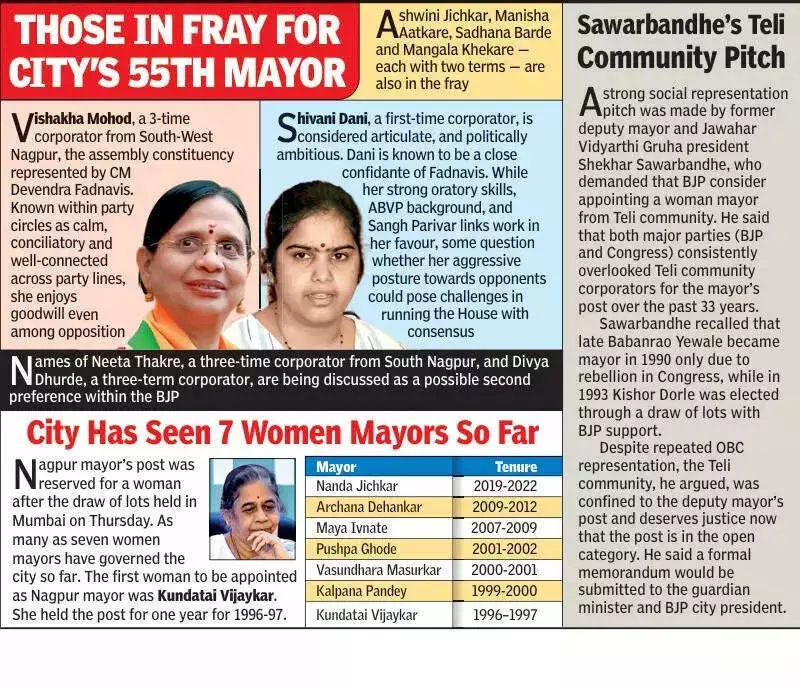
Among the prominent contenders, Vishakha Mohod stands out as a strong candidate. A three-time corporator from South West Nagpur, which happens to be the assembly constituency represented by Chief Minister Devendra Fadnavis, Mohod has been considered for the position since her first term itself. Known within party circles as calm, conciliatory and well-connected across party lines, she enjoys substantial goodwill even among opposition corporators.
Her long association with ABVP and her sustained rapport with Fadnavis and his family—though not familial—are viewed as major strengths that make her candidature one of the strongest in the race.
Another senior contender is Neeta Thakre, a three-time corporator from South Nagpur, while Divya Dhurde, also a three-term corporator, is being discussed as a possible second preference within the party. Additional candidates in the fray include Ashwini Jichkar, Manisha Aatkare, Sadhana Barde and Mangala Khekare—each with two terms of experience.
However, Khekare's prospects appear weakened due to strong resentment within party ranks, with complaints about her abrasive style and confrontational conduct creating obstacles to her candidacy.
New Dimension Added by First-Time Contender
Adding an intriguing new dimension to the race is first-time corporator Shivani Dani. Considered articulate, sharp and politically ambitious, Dani is known to be a close confidante of Chief Minister Fadnavis and has emerged as a serious claimant despite being a political rookie.
While her strong oratory skills, ABVP background, Sangh Parivar links and ability to represent the city at external forums work in her favor, some party leaders privately question whether her aggressive posture toward opponents could pose challenges in running the House with restraint and consensus.
Generational Debate Complicates Decision-Making
The selection process has been further complicated by a generational debate within the party. Of the 151 corporators elected this term, as many as 92 are first-timers, with a visible rise in young representatives. This demographic shift has triggered serious discussions about whether the BJP will signal a political shift by handing the mayor's gavel to a young, first-time representative.
The consideration gains additional weight following the party's recent elevation of young leadership at the national level—a development many see as an indicator that key posts may increasingly be entrusted to the next generation of political leaders.
As the BJP navigates these complex considerations, the Nagpur mayor election has become more than just a municipal appointment—it represents a critical test of the party's internal dynamics, its commitment to women's representation, and its strategic vision for urban governance in one of Maharashtra's most important cities.