The political landscape of Ladakh has been roiled by the emergence of a new socio-political group, leading to sharp accusations and counter-accusations between key stakeholders. The Voice of Buddhist Ladakh (VBL), formed on January 1, 2026, in Leh, has stoked significant controversy by claiming it will champion Buddhist community interests in the ongoing dialogue with the central government.
A New Player Enters the Fray
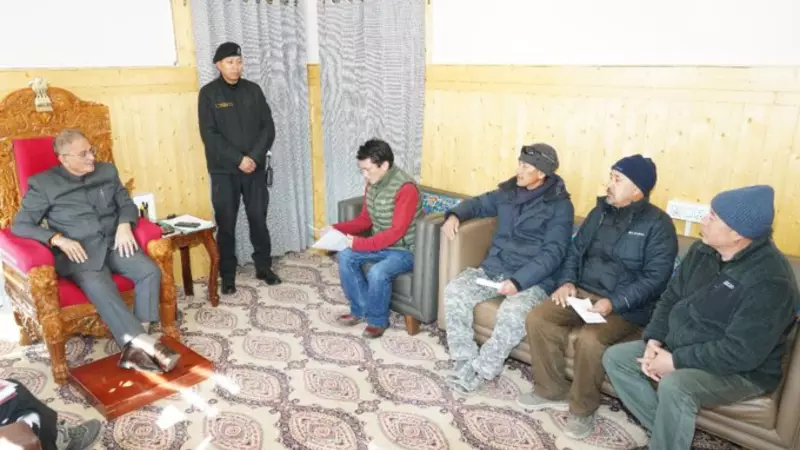
The VBL, led by its convener Skarma Namtak, asserts that the Buddhist population is "under-represented" in the High-Powered Committee (HPC) formed by the Union Ministry of Home Affairs (MHA). This committee is tasked with addressing Ladakh's demands, including statehood and constitutional safeguards under the Sixth Schedule. Namtak argues that the existing Leh Apex Body (LAB) has been "undermining Buddhist interests." The VBL's first major move was a delegation, led by Namtak, meeting with Ladakh Lieutenant Governor Kavinder Gupta on January 2 to present its stance.
However, this new initiative has been met with immediate and fierce resistance from the two primary bodies representing Ladakh: the Leh Apex Body (LAB) and the Kargil Democratic Alliance (KDA). Both groups have dismissed the VBL as a creation of the Bharatiya Janata Party (BJP), designed to "divide" the region's Buddhists and "drive a wedge" between the Leh and Kargil districts. Chering Dorjey Lakruk, vice chairperson of the LAB, explicitly labeled it a "BJP creation" meant to sow division.
Historical Context and Current Alliances
The friction comes at a sensitive time for Ladakh, a Union Territory with a population of approximately 2.74 lakh, where Muslims constitute 46.4% and Buddhists 39.65%. Historically, the Buddhist-majority Leh and Muslim-majority Kargil districts have had distinct political aspirations. However, the common demand for statehood and constitutional protections after Ladakh was carved out as a separate UT in 2019 brought them together in a rare joint struggle.
The LAB itself is a coalition that includes the influential Ladakh Buddhist Association (LBA) and the Ladakh Gonpa Association, which have represented Buddhist interests for over seven decades. The VBL's claim that Buddhists lack proper representation is therefore seen as a direct challenge to these established institutions. Sajad Kargili of the KDA dismissed the VBL as a "fringe element" with no ground connection.
Allegations and Counterclaims
Skarma Namtak has hit back at the allegations of being a BJP proxy, stating that such claims are expected from his detractors. "Of course, they will say it. Because they don't have anything else to say," he remarked. He emphasized that the VBL is not against any organization but solely focused on safeguarding Buddhist interests. Namtak also revealed that while a "large number of intellectual people" support the VBL, they prefer to remain behind the scenes.
The political atmosphere in Ladakh remains charged, especially after the violent protests in Leh in September the previous year, which resulted in four deaths and the arrest of activist Sonam Wangchuk under the National Security Act. The LAB and KDA view the VBL's formation, and its subsequent meeting with the LG, as a suspicious development aimed at fracturing their unified front just as the next round of HPC talks is anticipated around January 10. The VBL has insisted that Buddhist sentiments must be considered before these talks proceed, setting the stage for a complex political confrontation in the high-altitude region.