Bihar's Political Veteran Faces Unprecedented Challenge
After nearly two decades governing Bihar, Chief Minister Nitish Kumar confronts his most difficult political battle yet. The leader once celebrated as 'Sushashan Babu' for transforming Bihar after what many called the Lalu-Rabri 'jungle raj' era now faces growing voter skepticism and fatigue.
The Anti-Incumbency Wave After 20 Years
Nitish Kumar has ruled Bihar for close to 20 years, skillfully switching political alliances to maintain power. However, two decades of governance have created inevitable voter exhaustion. The leader once seen as the face of development and order now encounters an electorate demanding renewal and fresh energy.
Despite this growing discontent, many voters find themselves without clear alternatives. The BJP's national dominance and Prime Minister Narendra Modi's enduring popularity remain the NDA's strongest advantages, potentially counterbalancing Nitish Kumar's declining personal appeal.

Shift in Power Dynamics Within NDA
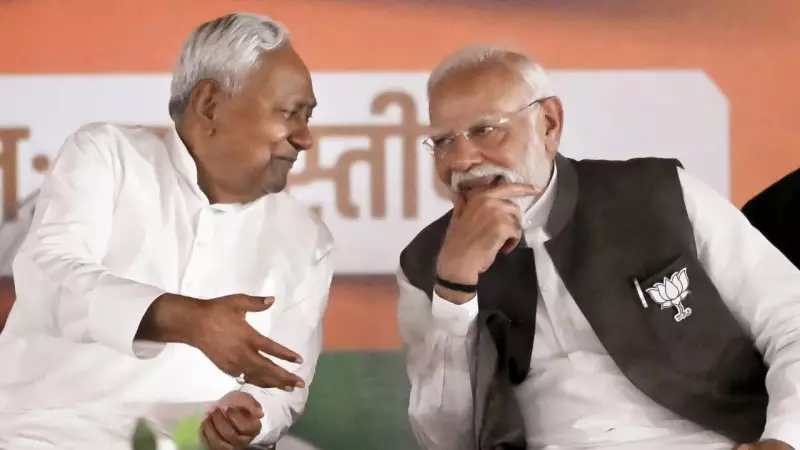
For years, Nitish Kumar acted as the 'big brother' in his alliance with the BJP, frequently dictating terms. This election season reveals a significant power shift. Under Modi's leadership, the BJP negotiated an equal seat-sharing arrangement with JD(U), with both parties contesting 101 seats each.
Despite this apparent parity, JD(U) has clearly lost the political leverage it previously enjoyed. In Bihar's complex political calculations, Nitish Kumar may now function as the junior partner in practice, even if official documents suggest otherwise.
Leadership Questions and Health Concerns
Recent public appearances where Nitish Kumar appeared to make missteps or display moments of incoherence have sparked discussions about his health and alertness. Opposition parties have capitalized on these incidents to question his fitness for leadership.
While these concerns might worry some voters, others view the BJP's strength under Modi as a stabilizing influence. With the saffron party holding just one seat less than the RJD in the state assembly and controlling the legislative council, many Bihar residents might still prefer the NDA for continuity and governance stability.
Economic Performance Versus Political Survival
Despite Nitish Kumar's two decades in office, Bihar continues to trail in GDP growth, income levels, and industrial development. The 'Sushashan' reputation no longer aligns with the state's economic reality. However, the BJP hopes that PM Modi's national narrative, emphasizing India's position as the 'world's fourth-largest economy,' will overshadow local dissatisfaction.
Promises of investment, employment opportunities, and infrastructure development from the Prime Minister could redirect attention from Nitish Kumar's mixed governance record toward Modi's broader development vision.
Statistical Evidence of Declining Influence
Nitish Kumar's political capital has undeniably diminished. His approval ratings as preferred chief minister have dropped significantly from 37% in 2020 to between 16% and 25% in recent surveys conducted by C-Voter and VoteVibe.
The JD(U)'s assembly strength has also experienced a sharp decline, falling from 115 seats in 2010 to just 43 seats in 2020. The party's vote share similarly decreased from 22.6% to 15.7% during this period. The once-dominant leader now finds himself increasingly dependent on Modi's popularity to maintain relevance in Bihar's evolving political landscape.
Youth Outreach and Political Strategy
The BJP, while lacking a strong state-level leader in Bihar, is investing in younger political figures like Chirag Paswan and Deputy CM Samrat Chaudhary to connect with first-time and young voters. This youth-focused approach, combined with PM Modi's mass appeal, might indirectly benefit Nitish Kumar by expanding the NDA's base against younger competitors such as Tejashwi Yadav and Prashant Kishor.
The BJP's campaign strategy merges Modi's leadership, Nitish's experience, and youthful energy into a unified message of stability and progress.

National Security and Electoral Impact
Following decisive military action against Pakistan-sponsored terrorism under his government's orders, Prime Minister Modi projected confidence during a rally in Bihar's Madhubani district, occurring just days after the Pahalgam terror attack.
The Prime Minister declared that those responsible for terrorist attacks would face severe consequences, stating India would identify, trace, and punish every terrorist and their supporters. From Bihar's soil, historically associated with Buddha's teachings of peace, PM Modi invoked the spirit of Yuddha (war), transforming the rally ground into a symbol of national determination.
For many voters, this combination of nationalism and strong leadership might resonate more powerfully than local issues.
The Final Political Calculation
Nitish Kumar may no longer command the authority or popularity he once enjoyed, but his political instincts remain sharp. His partnership with Modi's BJP offers what might be his final political lifeline, blending national leadership with local continuity.
Ultimately, if Nitish Kumar manages to retain power, it may result not from his own enduring appeal but through the strength of the Modi factor, once again redefining Bihar's political equilibrium.