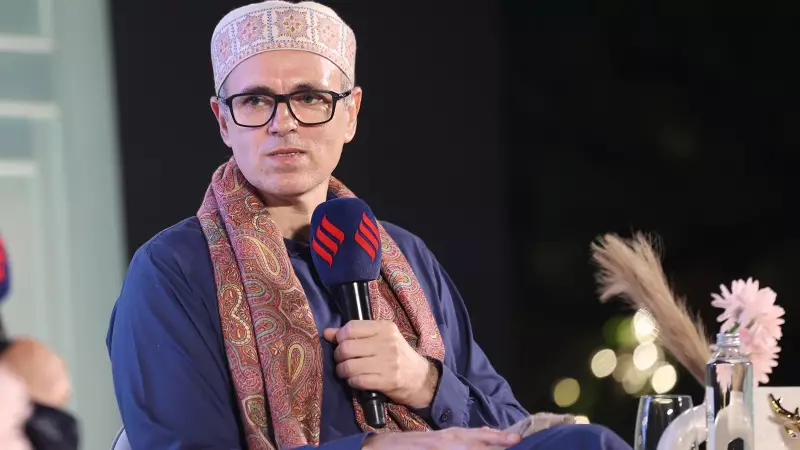
In a candid conversation at the Express Adda in New Delhi, Jammu and Kashmir Chief Minister Omar Abdullah expressed profound discomfort with the region's current constitutional status, stating he finds it difficult to reconcile the terms 'Union Territory' with 'Jammu and Kashmir'. The political scion and third-generation leader from the Abdullah family, who has served as both the youngest MP and Chief Minister, discussed a range of issues from the statehood demand and his equation with the Lieutenant Governor to the challenges of governance and the mood in the Valley.
A Persistent Ache: The Demand for Statehood
Marking one year of his government in October, Omar Abdullah was unequivocal about his resentment towards the Union Territory label. He revealed that he hates being reminded that J&K is a UT, questioning why he should be introduced as the Chief Minister of a Union Territory when he was never introduced as the Chief Minister of a State during his earlier tenure. He framed the restoration of statehood as an unfulfilled promise, pointing out that the Supreme Court and Parliament were told of a three-step process: delimitation, elections, and statehood. With the first two steps complete, he expressed disappointment at the delay in the third, urging the Centre to provide a clear timeline instead of the vague 'appropriate time'.
Governing a UT: Tensions with the LG and Centre's Role
While Abdullah maintained that his relationship with the Government of India, barring the statehood issue, has been positive—citing timely fund releases—he highlighted significant friction with the Lieutenant Governor, Manoj Sinha. He accused the LG of overstepping his defined role of handling only law and order and security. Abdullah listed several institutions that he believes should have been transferred to the elected government but remain under the LG's control. These include the J&K Power Development Corporation (where the LG is Chairman), the chancellorships of two universities, the chairmanship of the cultural academy, and even tourism development authorities, despite Abdullah holding the tourism portfolio.
He made a clear distinction between the Centre and the LG, though he acknowledged the worry that the latter's actions might have New Delhi's concurrence.
Kashmir's Mood, Radicalisation, and National Discourse
Addressing the public sentiment in Kashmir post the abrogation of Article 370, Abdullah rejected the notion of willing acceptance. He argued that the electoral results in the Valley, which favoured the National Conference, Congress, and PDP over the BJP, were proof of lingering discontent. He described a spectrum of opinion: from those who don't accept J&K as part of India, to BJP supporters, and a large middle section deeply unhappy but resigned to the current reality with no short-term solution in sight.
Abdullah expressed concern about radicalisation in certain quarters, citing the Delhi Red Fort blast. He also criticised the BJP's reaction to merit-based selections, like Muslim students dominating NEET admissions at a Mata Vaishno Devi-linked college or Kashmiri Muslims forming the majority of J&K's Santosh Trophy football team. He lamented the growing otherisation of Kashmiri Muslims, sharing anecdotes of students facing difficulties in finding rental accommodation elsewhere in India and linking it to a broader, worrying trend in the country's social fabric.
On the INDIA Bloc and Electoral Politics
Abdullah was frank about the challenges within the opposition INDIA alliance. He cited a lack of clarity on its long-term purpose and the immense difficulty during seat-sharing talks, which he found more stressful than candidate selection or campaigning. On the Congress's 'vote chori' (vote theft) campaign, he stated that while he believes in owning electoral defeats, he understands the need to challenge institutions like the Election Commission when they are perceived to be leveraged by the ruling party.
Broader Issues: Ladakh, Education, and Economy
The Chief Minister also touched upon other critical topics. He strongly criticised the handling of Ladakh, stating that the peaceful region was pushed to protest due to unfulfilled promises on protection of culture, land, and jobs. He condemned the treatment of activist Sonam Wangchuk. On education, Abdullah outlined a vision to elevate government schools to a standard where parents would prefer them over private institutions and to attract private investment in higher education. For the economy, he identified tourism, dairy processing, electronics, and IT parks as key sectors with competitive advantage, acknowledging the limitations of manufacturing in a resource-scarce, small market.
When asked about J&K's role in 'Viksit Bharat 2047', Abdullah pragmatically noted that while J&K would develop alongside the nation, the drivers of a developed India would be larger states, with J&K playing a smaller, supportive role.
The interaction, moderated by The Indian Express's National Opinion Editor Vandita Mishra, presented a leader navigating the complex realities of a truncated political mandate while forcefully advocating for the restoration of J&K's full constitutional stature.