

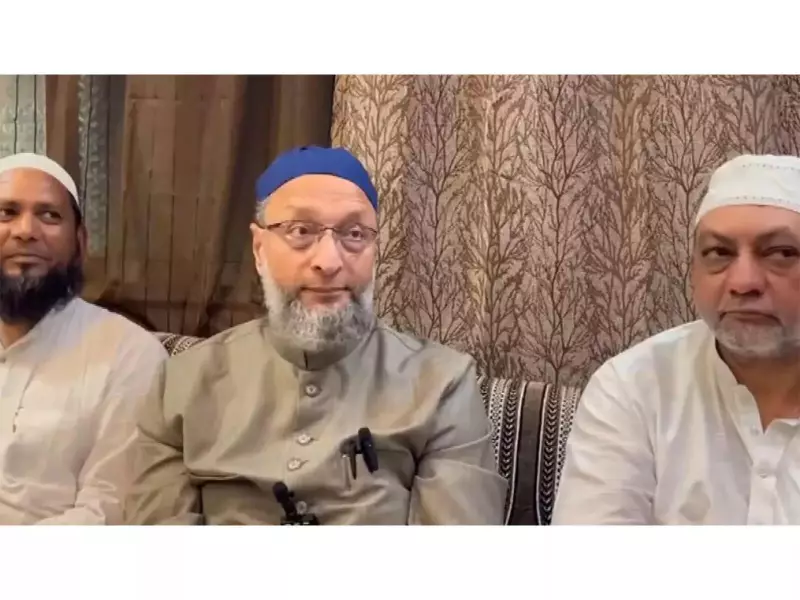
In a sharp critique of the Bharatiya Janata Party (BJP) government in Uttar Pradesh, All India Majlis-e-Ittehadul Muslimeen (AIMIM) national president Asaduddin Owaisi has accused the administration of employing absurd methods and arbitrary force. Speaking at a press conference in Amravati, Owaisi targeted Chief Minister Yogi Adityanath's government on multiple fronts, from alleged bizarre identity checks to controversial demolition drives.
Mocking 'Mobile Phone' Identity Tests and Targeting Madrasas
Owaisi sarcastically "congratulated" the Uttar Pradesh government for what he termed a new "invention." He was referring to recent reports where authorities allegedly tried to determine if a person was Bangladeshi by placing a mobile phone on their back. Owaisi stated that even leading scientists and the Indian Space Research Organisation (ISRO) would be stunned by this unscientific "technology." He questioned whether citizenship in India would now be decided by mobile phones, calling the action not just ridiculous but also unconstitutional and illegal.
Further escalating his attack, the Hyderabad MP claimed that after targeting mosques, the administration has now turned its bulldozers towards madrasas. He specifically cited actions in Uttar Pradesh's Sambhal district, where madrasas are being termed illegal and demolished. Owaisi alleged that the government is acting arbitrarily, misusing the law, and using the bulldozer as a political weapon against a particular community. The administration, however, maintains that these actions are solely against illegal constructions without any community bias.

Warning on Democratic Erosion and Electoral Malpractice
The AIMIM chief expressed grave concerns about the state of Indian democracy, levelling serious allegations against the Modi government and ruling parties. He claimed that electoral politics has descended from "vote theft" to "candidate theft." Owaisi alleged that in many places, candidates are being forced to withdraw nominations through intimidation, threats, or bribes, calling this a dangerous trend.
He warned that if voters are denied a candidate of their choice, the foundation of democracy weakens, reducing elections to a mere formality. Commenting on civic body elections, Owaisi said, "If elections are being held unopposed anywhere through intimidation, threats, or bribery, then it is a threat to our democracy." He appealed to all political parties to prioritize constitutional obligations and social harmony in their statements.
Questions on Foreign Policy and National Security
Owaisi also raised pointed questions about the central government's foreign policy and security strategy, highlighting apparent contradictions. He noted that after the terrorist attack in Pahalgam, India took a tough stance against Pakistan, even tightening water-sharing agreements. Yet, he pointed out, there was no hesitation in playing cricket matches against Pakistan in international tournaments. Owaisi labelled this a "double standard," asking why normal relations are pursued on the sports field while strong statements are issued on terrorism.
On the issue of Bangladesh, the AIMIM leader demanded a clear and transparent policy regarding illegal Bangladeshi nationals in India. He asserted that those living illegally should be deported through legal procedures, but the entire process must align with the Constitution and human values. He emphasized that political stability in Bangladesh is crucial for India's security, especially for the northeastern states.
Owaisi concluded by flagging strategic concerns, including increased Chinese activities near the Bangladesh border and the presence of elements linked to Pakistan's intelligence agency. He stressed that these issues must be viewed through the lens of national security, not just short-term politics.






