

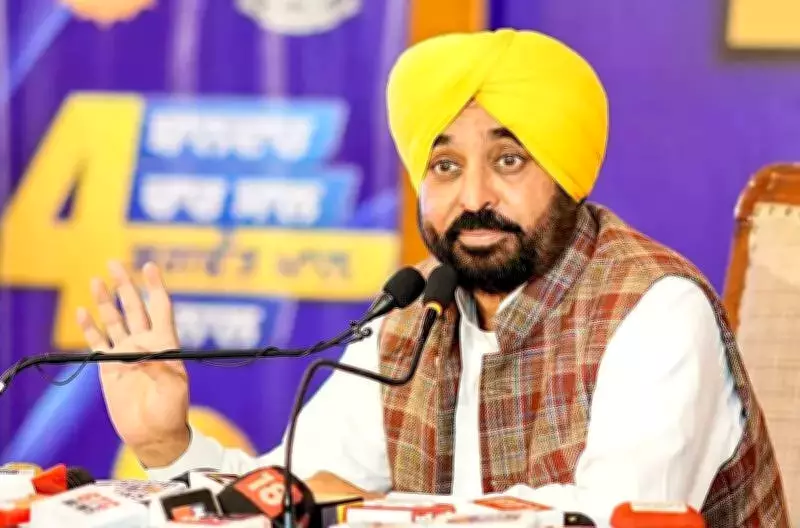
Punjab Chief Minister Revives Decades-Old Water Dispute with Massive Financial Claim
In a significant escalation of a long-running inter-state conflict, Punjab Chief Minister Bhagwant Mann on Wednesday formally demanded that the Rajasthan government pay a staggering Rs 1.44 lakh crore in outstanding dues. This colossal sum represents compensation for river water that Rajasthan has utilized from Punjab's share since the year 1960.
This recent demand is not an isolated incident but rather the latest chapter in a protracted dispute where the invaluable natural resource of water has been repeatedly quantified in precise monetary terms. The historical context reveals that financial calculations have been central to this issue for many years.
The Pioneering Calculations of Punjab's Water Expert
The late Pritam Singh Kumedan, widely regarded as Punjab's foremost authority on river water issues and a former adviser to the state government, laid the groundwork for such financial claims back in 2009. In a detailed analysis, Kumedan computed that while approximately 10.6 million acre-feet (MAF) of water had flowed to Rajasthan, Punjab had incurred an enormous cost of Rs 80,000 crore to extract an equivalent volume of subsoil water to meet its own critical irrigation needs.

That same year, Kumedan took the proactive step of writing to the then Chief Minister Parkash Singh Badal, urging him to formally raise this Rs 80,000-crore demand with the Rajasthan government. His meticulous work provided the foundational data for contemporary claims.
Detailed Breakdown of the Financial Burden on Punjab
As a former officer of the Punjab Civil Services (PCS), Kumedan was uniquely positioned to educate bureaucrats, politicians, journalists, activists, and legal professionals on the intricate constitutional and legal dimensions of river water disputes. In his comprehensive letter dated October 17, 2009, addressed to Chief Minister Badal, he elaborated on his calculations.
Kumedan stated that he had specifically calculated the costs of electricity and diesel required for extracting one crore acre-feet of groundwater annually over the preceding 40 years. His total arrived at Rs 80,000 crore. This figure represented the direct financial burden Punjab bore because it was deprived of equivalent river water from the Ravi and Beas rivers, which it could have used without incurring any such expenditure.
He explicitly clarified that this amount did not include any royalty payments or the intrinsic cost of the water itself. It solely accounted for the expenditure Punjab incurred to compensate for the substantial loss it suffered after being deprived of a major portion of its rightful share of the Ravi and Beas waters.
The Critical Water Shortage and Its Consequences
In an interview with The Times of India in August 2010, Kumedan, who passed away in August 2022, provided further critical insights. He argued that Punjab required approximately 50 MAF of water annually for irrigation purposes. Of this total, only about 25 MAF was sourced from canals and rainfall, forcing the state to extract the remaining volume from tubewells.
"Punjab could have utilized the 10 MAF for its own dire needs and would not have had to spend on power or diesel engines to draw subsoil water," he emphasized. He highlighted a severe imbalance, noting that the annual recharge of groundwater was only about 15 MAF, while the underground water table was depleting rapidly at a rate of 10 MAF per year.
Substantiating the Financial Claims with Regulatory Data
Kumedan's analysis was rigorously data-driven. By incorporating information from the Punjab State Electricity Regulatory Commission regarding power consumption for irrigation, he concluded that Punjab was utilizing 400 crore units of power, valued at Rs 2,000 crore annually, solely to draw 10 MAF of subsoil water.

Extrapolating this annual cost over the decades, he firmly estimated that Punjab had spent a total of Rs 80,000 crore on extracting groundwater to make up for the diverted river water. This detailed financial assessment forms the historical backbone of the current demand made by Chief Minister Bhagwant Mann, which now stands at an even higher Rs 1.44 lakh crore, accounting for extended periods and possibly additional factors.
The dispute underscores the severe economic and environmental costs borne by Punjab due to water-sharing agreements, with financial quantification becoming a central tool in seeking redress and highlighting the state's substantial losses over more than six decades.





