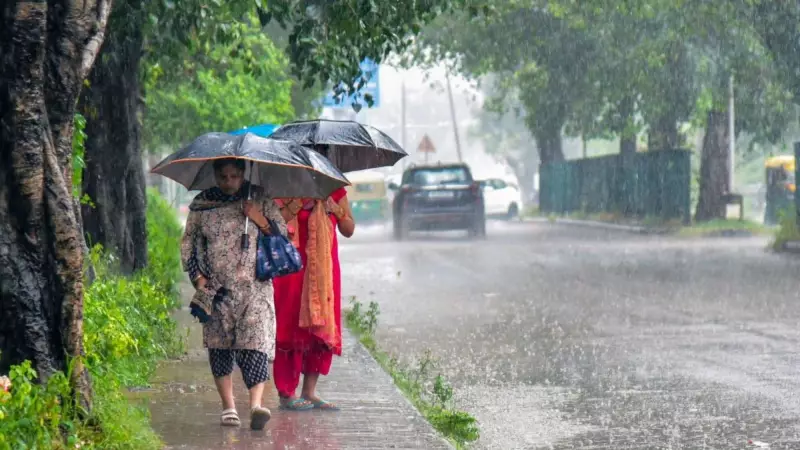
The New Year of 2026 brought a welcome, albeit brief, respite from the dry winter spell as light to moderate rainfall graced several parts of Punjab, Haryana, and the Union Territory of Chandigarh on Thursday, January 1. This first winter precipitation of the year offered temporary relief from the harsh, arid conditions that had gripped the region.
Rainfall Data and Agricultural Impact
According to official meteorological data, Chandigarh recorded the highest rainfall at approximately 13.7 mm. In Haryana, Rohtak received around 1.6 mm, Hisar 0.7 mm, and Mahendragarh about 0.6 mm. Several other districts witnessed very light showers, though many areas remained dry.
Punjab saw comparatively better rainfall in isolated pockets. Ludhiana recorded the highest at about 4.2 mm, followed by Jalandhar (2.4 mm) and Gurdaspur (2.2 mm). Hoshiarpur received 0.8 mm. However, districts like Amritsar, Ferozepur, and Mansa reported no rainfall.
Weather officials attributed this spell to the influence of a western disturbance over north India. They noted that while the overall rainfall remained below normal, it would help improve soil moisture for ongoing rabi crops and lead to a slight dip in temperatures.
Orange Alert: Dense Fog and Intensifying Cold Wave
The relief from the rain is set to be short-lived, making way for severe winter conditions. The India Meteorological Department (IMD) has issued an orange alert for Punjab, Haryana, and Chandigarh, warning of dense to very dense fog and cold wave to cold day conditions over the coming days.
The alert is in force for Punjab and Haryana for Friday and Saturday (January 2-3). Cold wave conditions are expected to peak on January 3. From January 4 onwards, these conditions are likely to persist at isolated places in both states.
In Punjab, cold day and dense fog conditions are expected from January 1-2 across multiple districts including Pathankot, Amritsar, Jalandhar, Ludhiana, and Patiala. On January 2 and 3, very dense fog is likely over Amritsar, Jalandhar, Ludhiana, and Fatehgarh Sahib, while a cold wave is expected to engulf parts of Faridkot, Bathinda, Mansa, and Sangrur.
Haryana is also bracing for dense to very dense fog during night and morning hours, with the cold wave intensifying. Chandigarh is likely to be among the worst-hit, experiencing very dense fog for nearly five days, severely reducing visibility.
Expected Disruptions and Health Advisories
The prevailing weather is likely to cause significant disruption to road, rail, and air traffic, especially during early morning hours due to poor visibility. There is also a possibility of power line tripping in areas experiencing very dense fog.
Health experts have cautioned that prolonged exposure to the cold and fog may increase risks of respiratory problems, asthma complications, eye irritation, and cold-related illnesses. Children, the elderly, and those with pre-existing conditions are particularly vulnerable.
Authorities have advised the public to avoid non-essential travel, drive cautiously using fog lights, remain indoors during extreme cold, ensure proper ventilation when using heating devices, and follow official advisories as the severe winter spell continues.