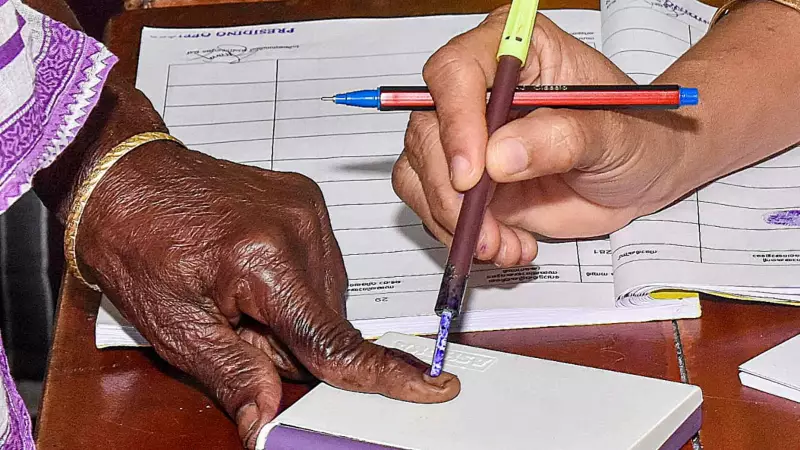
Punjab has recorded its lowest voter participation in rural local body elections in nearly two decades, marking a significant drop in electoral engagement. The recently concluded elections for Zila Parishad and Block Samiti bodies saw a turnout of just 48.40 per cent, a steep fall from the 68 per cent recorded in 2008.
A Steady Decline in Rural Electoral Participation
This year's figure continues a worrying trend of declining interest in Punjab's Panchayati Raj institution polls. The state witnessed a turnout of 63 per cent in 2013, which dipped to 58.10 per cent in 2018. The 2025 elections were held after a gap of seven years, following directives from the Punjab and Haryana High Court. Historically, these polls were conducted every five years during the terms of previous SAD-BJP and Congress governments.
Contrary to the national pattern where rural areas typically see higher turnout than urban centres, Punjab has consistently shown a lack of enthusiasm for these polls. This year, Amritsar district recorded the poorest participation at 38.62 per cent, while Malerkotla saw the highest at 56.37 per cent. Several key districts, including Tarn Taran, Jalandhar, Patiala, Ludhiana, and Gurdaspur, all registered turnouts below the 50 per cent mark.
Opposition Labels Low Turnout as "Silent Protest" Against AAP
The political opposition in Punjab has been quick to interpret the dismal numbers as a strong message against the ruling Aam Aadmi Party (AAP) government. Leader of Opposition, Congress's Partap Singh Bajwa, stated that people have lost faith in the sanctity of the electoral process due to the "excesses" of the ruling party and blatant misuse of administration. "Choosing not to vote becomes a silent protest against a police-managed and compromised electoral process under the AAP government," Bajwa remarked.
Punjab BJP chief Sunil Jakhar echoed this sentiment, suggesting voter disillusionment led to the apathy. "They thought that since defeating the government in these elections would not solve their problems, it was better to stay at home," Jakhar said. The Shiromani Akali Dal (SAD) went a step further, accusing the AAP of colluding with the State Election Commission and Punjab Police to "steal" the elections. The party demanded a judicial probe and the immediate removal of the SEC.
AAP Retort and Expert Analysis on Eroding Trust
The AAP government strongly rebutted the allegations. Party spokesperson Baltej Pannu highlighted that the elections under their watch were conducted peacefully, in contrast to the past. "Murder cases were registered during their regimes. During AAP’s term, these elections have taken place peacefully," Pannu asserted, addressing repolling in 15 locations by clarifying it was due to misprinted ballot papers, not violence.
Political experts point to a deeper, systemic issue. Jagrup Singh Sekhon, a retired professor of Political Science from Guru Nanak Dev University, Amritsar, explained that voter participation hinges on faith in institutions. "People have lost faith in these institutions and processes... During the Akalis regime, excesses had surpassed all previous records. During Congress rule, it had declined and now the AAP has crossed all limits," Sekhon observed. He added that the AAP's lack of a strong village-level organisational structure and ideology has further alienated the common voter.
The sharp 10-point drop from 2018 to 2025, compared to 5-point declines in previous terms, underscores a growing crisis of confidence in Punjab's grassroots democratic exercise, raising serious questions for all political stakeholders.