

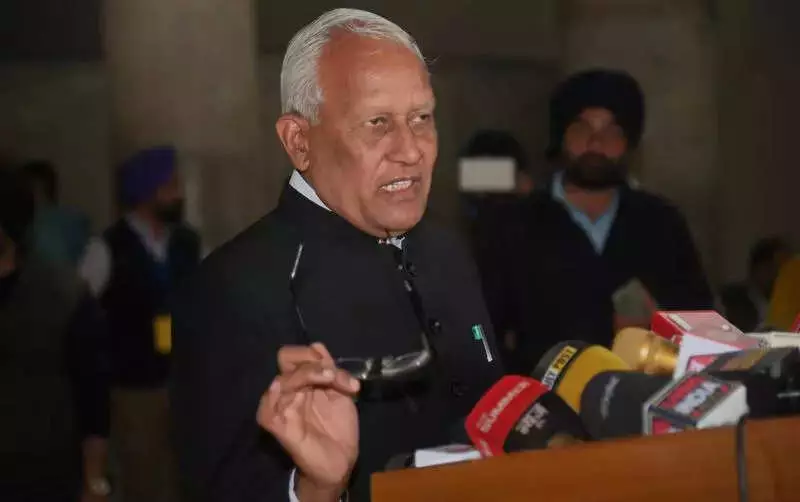
Punjab's Water Resources Minister, Barinder Kumar Goyal, launched a fierce attack on the Congress-led Himachal Pradesh government on Tuesday, accusing it of imposing a "baseless and illegal" financial burden of Rs 500 crore on the Bhakra Beas Management Board (BBMB). He termed the move a brazen assault on federal principles and a direct conspiracy against Punjab's financial interests.
The Core of the Controversy: A 2% Land Cess
At the heart of the fresh interstate conflict is a 2% 'Bhumi Maliya Cess' (annual land revenue on surplus land for non-agricultural purposes) introduced by the Himachal Pradesh government. The formal gazette notification for this levy was issued on December 12, 2025, and it came into effect on January 1, 2026.
Minister Goyal asserted that this newly imposed cess would lead to a staggering 20% increase in BBMB's annual budget. As the major stakeholder in the BBMB, Punjab would be forced to shoulder the lion's share of this burden. He estimated that the BBMB would have to pay nearly Rs 436 crore annually, imposing an additional burden of around Rs 200 crore each year on Punjab's state treasury.

Punjab's Stance and Legal Threats
Goyal was unequivocal in his condemnation, stating that the arbitrary decision directly harms Punjab's interests. "We have formally written to BBMB, clearly stating that this levy is unlawful and unacceptable," he told the media. The minister vowed to pursue the matter relentlessly before the BBMB, in courts, and at every possible forum.
He accused the Himachal government of cooking up this "dubious levy" after its previous attempt to introduce a water cess was struck down by the high court. "No one knows which law they invoked, where this tax originates, or under what authority they arbitrarily assessed the value of land, machinery, and infrastructure on their own," Goyal questioned, calling it another example of Congress' "habitual high-handedness."
From Water Cess to Land Cess: A Strategic Shift
The transition from the proposed water cess to the Bhumi Maliya cess is seen as a strategic legal shift by the Himachal Pradesh government. The previous water cess, levied on the volume of water drawn for power generation, was struck down by the Himachal Pradesh High Court. The court ruled it was essentially a disguised tax on electricity—a subject under the central government's jurisdiction.
In contrast, the new 2% Bhumi Maliya cess is framed as land revenue, which is a state subject. This move is viewed as an alternative revenue-generation strategy to circumvent the constitutional hurdles that doomed the water cess. Both the BBMB and the Punjab government have formally objected, arguing it is the water cess in a different garb.
This levy has triggered a fresh conflict between the neighbouring states, adding to existing tensions. The two states are already locked in a legal battle over the Shanan hydropower project in Jogindernagar. Punjab currently operates the 110 MW plant under a 99-year British-era lease that expired in March 2024. While Himachal demands its return, Punjab claims permanent ownership, making this new financial dispute another flashpoint in their complex relationship.






