

R K Nagar's Political Decline: From Jayalalithaa's Glory to Neglected Streets
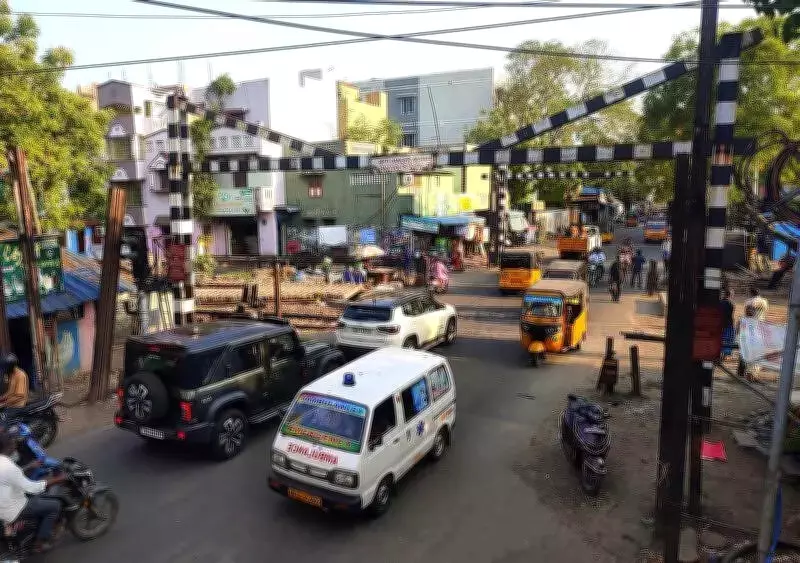
On a recent Sunday morning, the streets of Dr Radhakrishnan Nagar, commonly known as R K Nagar, presented a scene of everyday struggle. Around ten people were jogging along Ennore High Road, while several men in their 50s and 60s walked directly on the road due to the absence of proper pavements. In the Tsunami Quarters at New Washermenpet, residents formed long queues with buckets as a water lorry slowly filled a public tank, highlighting the acute water scarcity. Meanwhile, at the railway gate on the high road towards Tiruvottiyur, vehicles piled up for nearly forty minutes waiting for a train to pass, causing significant traffic disruptions.
A Legacy of High-Profile By-Elections
Despite these visible challenges, political campaigning in the area remains surprisingly lacklustre. This is a stark contrast to the high-visibility by-elections that once made this constituency famous across Tamil Nadu. The political significance of R K Nagar began with then Chief Minister J Jayalalithaa's strategic decision to contest the 2015 by-election from this stronghold of her AIADMK party. The DMK boycotted that election, allowing Jayalalithaa to secure a massive victory by 1.5 lakh votes, while CPI candidate C Mahendran garnered only 9,710 votes.
The second by-election, held after Jayalalithaa's untimely death, further cemented R K Nagar's notoriety but for all the wrong reasons. It became synonymous with cash-for-votes scandals, leading the Election Commission to cancel the poll. T T V Dhinakaran eventually won the rescheduled election in 2017. "There were visible improvements after the victory of Jayalalithaa. We got housing board flats with basic facilities. But after Dhinakaran's win in 2017, the attention for the constituency declined dramatically," lamented M N Ramesh, an AIADMK functionary.

Decay and Disillusionment Among Residents
Nearly a decade later, residents across R K Nagar report that everything has deteriorated. "In our area, it is easier to buy drugs than groceries. I see children smoking and consuming alcohol every day. There is no proper patrolling or action by authorities," said M Charles, an auto driver from the constituency. Jayalalithaa's victory had initially brought much-needed attention to this area, which has a large fishermen population, port-linked labour communities, and numerous resettlement colonies.
"Before 2015, the R K Nagar constituency was widely considered a slum area. When Jayalalithaa became the MLA, even small issues were sorted immediately," recalled R Loganathan, a district executive committee member of the CPM. "In 2016, large-scale resettlement colonies were constructed. However, after Jayalalithaa's demise, even the AIADMK has largely ignored this constituency," he added.
Recent Political Shifts and Unresolved Issues
The DMK broke a twenty-year drought by winning the seat in 2021. Over the past five years, some long-pending infrastructure projects have been addressed, including:
- Flyovers over railway crossings at Ezhil Nagar and Korukkupet
- A new bus stand at IOC Nagar
- A new bus terminus in Tondiarpet
- Construction of a sports complex
Despite these developments, legacy issues persist severely. Drug abuse remains rampant, piped water supply is inadequate, traffic congestion at railway crossings continues unabated, and road conditions are poor. In the upcoming election, DMK has fielded sitting MLA J John Ebenezer, while AIADMK has nominated R S Rajesh, who lost previously. Other notable candidates include TVK's N Marie Wilson, managing director of Jeppiaar Institute of Technology, and NTK's Vennila Thayumanavan, an environmental activist.

Voter Discontent and Unmet Promises
The prevailing sentiment among many residents is one of deep disillusionment. "Last year, we protested for more than 150 days against the privatisation of the National Urban Livelihood Mission. The government ignored our plea completely. Now, suddenly, everybody shows up at our houses seeking votes. For five years, nobody came, not even during floods. Why should we vote for anyone if our lives are not going to change?" questioned K Shanthi, a sanitary worker and resident of Annai Sathiya Nagar. Fishermen in the constituency have also voiced similar frustrations, stating that their core demands remain unmet by successive administrations.
The contrast between R K Nagar's past political prominence and its current state of neglect serves as a poignant reminder of how electoral attention can fade, leaving communities to grapple with enduring challenges without sustained support.





